Jeanne Hoffman, of Kosmos Online, a project sponsored by the friendly folks at the Institute for Humane Studies, recently recorded a podcast interview with me. Our discussion covered such things as career engineering, how IHS helped me win freedom, and the current state of intellectual property scholarship. You can listen here or read a rough transcript here.
Showing posts with label intellectual property. Show all posts
Showing posts with label intellectual property. Show all posts
Wednesday, February 09, 2011


Monday, June 28, 2010
Barbie, Political Philosopher
Toy Story 3 offers many pleasures and not a little wisdom. I absorbed them with a shocking output of tears, both the laughing kind and otherwise. At one point, too, I raised my fist in solidarity, moved by the political philosophy voiced by Barbie (brilliantly played by Barbie). I liked Barbie's quote so much that I put it on a t-shirt:

Nice, huh? Click on the picture to customize the shirt for your build and style.
Fellow Bluebook geeks will notice that, despite its graphic fripperies, the shirt sports a proper legal citation. Scholars might take comfort in the fact that I crosschecked the quote against the junior novel version of Toy Story 3. Lawyers for Disney/Pixar must admit that my usage falls within the traditional bounds of the fair use defense to copyright infringement, and Hasbro cannot justly complain that the shirt's use of "Barbie" violates that trademark.
Tyrants might not like the shirt, granted. But Barbie showed us what happens to tyrants. I won't say more about that, here; just go see the movie!
UPDATE: Notwithstanding law and logic, Zazzle.com pulled the shirt almost immediately after I posted it for sale. I'm currently trying to correct the matter. Sorry for the inconvenience.
[Crossposted at Agoraphilia and The Technology Liberation Front.]
Monday, June 14, 2010
You Might Do Not Have to Use Files
The grandly-named Public Domain Archive, evidently a production of Osaka-based Digirock, Inc., offers a few MP3s of classical music and historical speeches. Thanks to a suggestion from Tyler Cowen, I'm enjoying a 1942 recording of Beethoven's 9th even as I type. Am I breaking the law in so doing? The copyright notice posted on the Public Domain Archive, while quite charming, hardly reassures:
To the People
In japan, All files open to the public on this site are certainly lawful.
But, if you do not live in Japan, You might do not have to use files.
You should check the law of your country.
As proves too often true for works, like this 1942 recording, that fall under the aegis of the 1909 Copyright Act, it is not easy to figure out if the underylying work enjoys any claim to protection under U.S. law. Perhaps, after all, it was not published with the proper formalities, here, and thus fell into the public domain.
In this case, though, it looks like we can dodge those complications. U.S. copyright law affords exclusive rights only to copying, creation of derivative works, public distribution, public performance, and public display. See 17 USC § 106. So long as I listen to a MP3 solely via streaming, without saving a copy, it is hard to see how I've violated any of those rights. Perhaps Digirock, Inc. has violated U.S. law by offering me the MP3, but that is no concern of mine (and probably not much of a concern to Digirock, Inc.).
That legal scenario suggests an interesting conclusion: an offshore copyright-free zone—one set up by intellectual pirates or in a stubbornly independent country—might give U.S. residents ample, free, and legal access to all sorts of copyrighted works—even ones protected under U.S. law.
[Crossposted at Agoraphilia and The Technology Liberation Front.]
Monday, August 10, 2009
Free Willie?
Thanks to comments on my earlier post, Copyright Duration and the Mickey Mouse Curve, I've been encouraged to reflect on what would happen if, in fact, Steamboat Willie had fallen into the public domain. Could we then reuse Mickey Mouse, the star of that show, without facing any liability to the Walt Disney Company? I drafted this answer for my book, Intellectual Privilege (here edited for blogging):
Scholars have made surprisingly strong arguments that Steamboat Willie, a cartoon that the Walt Disney Company cites as establishing its copyright rights in Mickey Mouse, has fallen into the public domain. As a thought experiment, let us assume the truth of that claim. What would happen if Walt Disney Company—if, indeed, nobody—held a copyright in Steamboat Willie? Certainly, each of use would by default enjoy complete freedom to copy, distribute, display, or perform the cartoon, because the expiration of the work's copyright would also end the exclusive rights of the Walt Disney Company and its assigns the exercise those statutory privileges. So, too, would we escape copyright's limitations on making derivative versions of Steamboat Willie—versions that might show Mickey standing at a lectern rather than at a pilot's wheel, for instance, or have him expounding on copyright law.
The Walt Disney Company would retain its copyrights in later, plumper versions of the Mickey Mouse, of course. Contemporary artists wanting to reinterpret the character free from the company's veto would thus have to draw inspiration primarily from the earlier, skinnier, version. Given that the characters would share a common ancestor, however, even mice derived solely from Steamboat Willie would often strongly resemble the modern-day Mickey Mouse.
Would Walt Disney Company object to those unauthorized reuses of Steamboat Willie? It might, indeed. Some such uses might substitute for sales of the company's wares, after all, or cast its most prominent spokes-mouse in an unsavory light. But copyright law would, per the assumption behind our thought experiment, offer the company no solace. The Walt Disney Company could not plausibly claim that patent or trade secret law gives it the power to limit free use of Steamboat Willie, either. Nor could it invoke the right of publicity, which though sometimes shockingly effective in limiting speech about celebrities, has thus far not stretched to cover cartoon characters.
Trademark and unfair competition law would probably offer the Walt Disney Company its most potent weapon against any movement to emancipate Steamboat Willie. Generally speaking, that area of law allows the holder of a name, symbol, or other mark to prevent latecomers from using in commerce marks likely to confuse consumers about the source or affiliation of a particular good or service. Thus, for instance, can Nike bar someone from putting its famous "swoop" on non-Nike clothes. The Walt Disney Company uses Mickey Mouse as a mark designating its goods and services. If a consumer did not know (ex hypothesis) that the image and voice of Mickey Mouse, qua the character Willie, had fallen into the public domain, and that consumer saw a cartoon of a substantially similar Mickey Mouse in a new context, the consumer might naturally, yet wrongly, assume that the newer Mickey Mouse had issued from the same source as so many other cartoons featuring the character: The Walt Disney Company. On that argument, consumer ignorance would give the company cause to censor derivative versions of the copyright-free Mickey Mouse.
Perhaps the addition of disclaimers, such as noting, "Not a Walt Disney Company production!" in a cartoon's margin, would suffice to dispel consumer confusion. That would ward off only a "passing off" claim—one where a mark's holder accuses another of selling bogus wares under that mark—however. The same disclaimer would set the defendant up for a "reverse passing off" claim—one where Disney would charge that cartoonist wrongly sold Disney's product (intellectual creations about Mickey Mouse) under another's name. Disney could thereby damn those who use Steamboat Willie both if they do use disclaimers and if they do not. Happily for anyone who wants to free Willie, however, the Supreme Court has cut through that Gordian knot of liability.
The Supreme Court held in Dastar Corp. v. Twentieth Century Fox Film Corporation that, once a work has fallen into the public domain, its former copyright holder cannot use federal unfair competition law to demand credit from those who reuse the work. Still more broadly, the Court flatly excluded copyrighted works from the scope of section § 43(a)(1)(A) of the Lanham Act, the federal law barring passing off, whether direct or reverse. The Court explained the policy reasons for thus limiting unfair competition law:
Assuming for the sake of argument that [defendant] Dastar's representation of itself as the "Producer" of its videos amounted to a representation that it originated the creative work conveyed by the videos, allowing a cause of action under § 43(a) for that representation would create a species of mutant copyright law that limits the public's "federal right to 'copy and to use,'" expired copyrights.
Dastar voiced broad concerns, and lower courts have read it accordingly. They have extended it to bar state law claims of unfair competition, a result the U.S. Constitution's Supremacy Clause would apparently mandate. Lower courts have also extended Dastar to bar unfair competition claims arising out of the use of uncopyrighted and uncopyrightable works. Plainly, the case has done a great deal to ensure that copyright's privileges go no farther than copyright itself.
The exact scope of Dastar's preemptive effect remains as yet uncertain, granted. Even if it suffered the uncopyrighting of Steamboat Willie we've hypothecated here, for instance, the Walt Disney Company would perhaps still have the right to bring suit under § 43(a)(1)(B) of the Lanham Act against those using liberated versions of Mickey Mouse to deceptively market their wares, such as by falsely advertising a new Spaceship Willie as a Disney original. The Dastar Court left that question open. Lower courts have, however, read the case to bar § 43(a)(1)(B) claims alleging no more than false marketing about whether permission was granted for an uncopyrighted work. Under that reasoning, the Walt Disney Company could not even stop the authors of Spaceship Willie from selling it as, "A wholly original take on Mickey Mouse," or, conversely, as "Mickey Mouse in the finest tradition of Walt Disney." Thus might Dastar and its progeny help Mickey Mouse, when and if he escapes copyright, from achieving the status of a great cultural icon, akin to Santa Claus or Uncle Sam.
[Crossposted at Agoraphilia, TechLiberation Front.]
Tuesday, July 28, 2009
Unconstitutional Copyrights?
As part of a revise-and-resubmit process, I've been spending much of my summer upgrading my draft book, Intellectual Privilege: A Libertarian View of Copyright. That effort has led me to revisit copyright's constitutional foundations. I find them very shaky, indeed. This passage (with footnotes excerpted) explains why modern copyright law often fails "to promote the Progress of Science and the useful Arts":
What would copyright look like if we took the Constitution at its word, requiring that copyright promote the progress of both science and the useful arts? We would then have to look askance at the current practice of affording copyright protection to such purely artistic creations as songs, plays, novels, paintings, and sculptures. Even supposing that "science" reaches broadly enough to cover all of the humane sciences—a reading that Malla Pollack documents as an original meaning of the term—copyright law today focuses far more on the expressive arts than on the "useful" ones.
Taking "Science and useful Arts" seriously would thus radically narrow the proper scope of copyright. The first Copyright Act, enacted in 1790 by some of the same people who wrote and ratified the Constitution, covered only maps, charts, and books. Permitting copyrights in first two types of works plainly promoted both science and the useful arts. Lawmakers in 1790 probably regarded books, too, primarily as tools rather than diversions. Novels had yet to rise to prominence, after all; the first American one, William Hill Brown's THE POWER OF SYMPATHY, had appeared only the year before, and even it aimed at practical ends, promising "to Expose the fatal consequences of SEDUCTION." Judging from the titles in libraries and on sale, fiction made up only a small portion of the books available in late eighteenth century America. The 1790 Copyright Acts moreover excluded such purely artistic expressions as songs, plays, paintings, and sculptures—even though its drafters undoubtedly knew of and appreciated those sorts of works.
It appears, then, that "[t]o promote the Progress of Science and useful Arts" originally meant that that copyrights had to serve practical ends, rather than merely expressive ones. But originalists should not alone embrace that constitutional limitation on copyright's scope. Given that "Science" now connotes a more technical and specialized endeavor than it did in the eighteenth century, the plain, present, public meaning of the Constitution likewise counsels against extending copyright protection to purely artistic works. Whether we give the Constitution's text its original meaning or its current one, therefore, copyright should cover little more than maps, charts, non-fiction books, illustrations, documentaries, computer programs, and architecture. Most songs, plays, fictional books, paintings, sculptures, dances, movies, and other artistic works, because they fail to promote the progress of science and the useful arts, would on that reasoning not qualify for copyright protection.
However rigorously logical, that argument against the constitutionality of almost all modern copyright law will, I grant, probably generate more grins than agreement. Courts and commentators have hitherto hardly bothered to distinguish between "Science and useful Arts"; still less have they taken those words to impose real limitations on federal power. Here as elsewhere, acquiescence to long-accepted practices has dulled us to the Constitution's bracingly straightforward words. We should read them anew and reflect that the Founding generation did not evidently think that granting statutory privileges to such purely artistic creations as romantic operas or pretty pictures would promote the progress of both science and the useful arts. Furthermore, most citizens today would, if presented with the Constitution's plain language rather than the convoluted arguments of professional jurisprudes, probably say the same thing about pop songs, blockbuster movies, and the like. That is certainly not to say that purely expressive works lack value. They may very well promote such important goals as beauty, truth, and simple amusement. The Constitution requires that copyright promote something else, however—"the Progress of Science and useful Arts"—and a great many works now covered by copyright cannot plausibly claim to do both.
This argument against the constitutionality of most modern copyright relies, by the way, on a prior argument about the structure of the copyright clause; to wit, that "Science and useful Arts" modifies both "authors" and "inventors." Also, I intend to follow up the above with an analysis of how the Supreme Court in Eldred took a view almost exactly opposite to the text-based one I've embraced. (I'd call that an admission, were I not proud to disagree with the Court.)
[Crossposted at Agoraphilia, TechLiberation Front.]
Wednesday, July 01, 2009
Recipe for a Force Field
We don't yet have flying cars, much less jet packs. I like our Roomba, but domestic robots still have far to go before they can whip up an omelet, set the table, and pour the coffee. In these and many other areas, technology continues to lag behind the rosy sci-fi scenarios of my youth. Allow me, then, to give the future a little kick in the pants by describing how to build a long anticipated and long overdue technology: The force field.
Start with a phase conjugate mirror. A conventional mirror simply reflects light, bouncing it off at an angle in the same way that the bumper on a pool table redirects the motion of a ball. A phase conjugate mirror, in contrast, reflects light in exactly the reverse direction and form as the light comes in. Banking shots would be impossible on a pool table with "phase conjugate" bumpers, as balls would always bounce back in exactly the same direction whence they came.
Add to the phase conjugate mirror this additional ingredient: pumping beams that create a amplified reflection of the incoming wave front. (Read the bit under "phase conjugate mirror" at this source for more details.) To recur to the pool table example, it would be as if you gently tapped a ball at a bumper and it came speeding straight back at you.
Lastly, top off the amplified phase conjugate mirror with an illumination beam—a laser that rapidly scans the protected area, say. This illuminating beam can operate at relatively low power levels, given that it serves only to bounce a few photons off of the target. When some of those illuminating photons find their way from the target to the amplified conjugate phase mirror . . . BAM! Out flashes a blast of electromagnetic energy, automatically aimed on-target.
To better understand how the force field works, consider a ready application: Protecting spacecraft from orbiting debris. A scanning laser would rapidly sweep the area from which space junk would most likely approach the protected craft. Most of the time, of course, that beam would dissipate into empty space and the force field would remain quiet. When the scanning laser illuminated an approaching threat, however, the phase conjugate mirror would bounce a beam of electromagnetic energy right back at the debris (or, what would in practice amount to the same thing, given the speed of light, at the location the debris occupied an flash earlier). With enough amplification, the phase conjugate mirror could alter the trajectory of the approaching junk, directing it away from the spacecraft. With more amplification, the force field could simply vaporize the threat.
I could say more, but readers who have read this far can probably work out other interesting applications of the force field, as well as the problems introduced by non-reflective or highly reflective targets and the remedies afforded by using different frequencies for the scanning and amplified beams. Some readers might quibble that, regardless of its merits, I've not really described a force field, but rather only something that appears to function like one. Given that sci-fi authors don't typically explain how force fields work, though, I don't feel too bad about borrowing the label.
I don't claim this recipe for a force field as any sort of breathtaking innovation, granted. Once you get your head around phase conjugate mirrors, the rest of what I've suggested falls into place pretty quickly. I guess you could call it obvious to one reasonably skilled in the relevant arts—dynamic holography—and, thus, unpatentable. Still, though, I've yet to find any references on the 'net about this method of creating a force field.
Given that I make my living as a law prof, rather than a non-linear optical scientist, you might wonder why I dabble in these topics. It turns out that I've long had an interest in holograms. I set up a home lab to make them when I was in high school, and later developed a holographic information processing system that, in theory at least, answered a challenge that a hero of my youth, Douglas Hofstadter, put to me personally. His response left me so disillusioned that I abandoned my plans to pursue a degree in AI, but that is another, much longer story.
Friday, November 14, 2008
Sensible Khakis: An Entrepreneurial Anthem
Entrepreneurs rock! You wouldn't guess it, though, to listen to rock music. (Marc Knopfler's, Boom, Like That, says something about the founding and rise of McDonald's, granted, but it hardly casts the enterprise in a very flattering light.) So in honor of entrepreneurs everywhere—but especially those in the board sports industries, whom I thank for making some very fun toys—I offer Sensible Khakis:
Like Take Up the Flame, which I coughed up on YouTube last week, Sensible Khakis' license leaves you free to play it just for fun. You can find the chords and lyrics—including the law-geek verse, not included in the video above, about the choices entrepreneurs face between sole proprietorships, corporations, LLPs, and LLCs—here. Like the terms attached to Take Up the Flame, any commercial licensees of Sensible Khakis will have to pay a tithe to one of my favorite causes—this time, Surfrider Foundation. That is not a likely scenario, admittedly, but I figure that the thought counts for something.
[Crossposted at Agoraphilia and Technology Liberation Front.]
Tuesday, August 12, 2008
Name that Law School
Law schools don't seem to care very much about staking out original names. Consider two Orange County law schools: Irvine University College of Law (founded in 1993), and the University of California, Irvine School of Law (which should start accepting student applications this fall). Imagine the confusion that will follow when local attorneys start saying, "I graduated from Irvine."
That is not to say that the presence of two "Irvine" law schools will cause consumer confusion—the acid test of trademark (or, as here, service mark) infringement. Any prospective law student would sort out the two schools long, long before applying for admission. Clients and members of the general public, who don't care so much about such things, might get the two "Irvine" schools mixed up, but that would probably not give rise to an actionable infringement claim.
Note, too, that there seems to be no bad intent. Irvine University first opened in the city of Irvine, only later moving to its present home, in nearby Cerritos. And, of course, nobody could plausibly claim that U.C. Irvine School of Law adopted its name to poach on its predecessor's good will.
The two "Irvine" law schools will thus probably have to learn to live and let live. It that, they'll join such law schools as John Marshall (Chicago) and John Marshall (Atlanta); University of St. Thomas University (Minnesota) and St. Thomas University (Florida); and Washington University (Missouri); University of Washington (Washington); and George Washington University (District of Columbia).
Unlike those schools, granted, the two "Irvine" schools will share the same geographic market. New York Law School and New York University School of Law share that fate, though, and appear to coexist quite happily. It perhaps helps that the latter goes by "NYU"—a strategy that U.C. Irvine might do well to emulate. It that event, Orange County would have not two "Irvine" law schools but, in effect, one named "Irvine University" and another named "UCI."
[Crossposted at Agoraphilia, and MoneyLaw, and College Life O.C.]
Saturday, August 02, 2008
A Copyright Giant Gives Up in Disgust
I regret to report the end of William F. Patry's Copyright Blog. Patry, author of a superb multi-volume treatise on copyright law and Google's Senior Copyright Counsel, not only offered a feast of news and commentary for copyright geeks; he offered it up in style. Consider this, among the many sound reasons he cites for ending his blog:
Copyright law has abandoned its reason for being: to encourage learning and the creation of new works. Instead, its principal functions now are to preserve existing failed business models, to suppress new business models and technologies, and to obtain, if possible, enormous windfall profits from activity that not only causes no harm, but which is beneficial to copyright owners. Like Humpty-Dumpty, the copyright law we used to know can never be put back together again: multilateral and trade agreements have ensured that, and quite deliberately.
In short, Patry found blogging about copyright simply too depressing to keep up. I certainly understand that feeling, though I find righteous indignation a fair remedy for weary sadness. At any rate, I thank Patry for his long and selfless blogging, wish him happier diversions, and look forward to the day when we can discuss copyright's reformation with smiling pride.
[Crossposted at Agoraphilia and Technology Liberation Front.]
Monday, June 16, 2008
Cato Unbound: Towards a Copyriot Act
Cato Unbound today published my reaction to Rasmus Fleisher's lead essay on the future of copyright. My essay, titled Towards a Copyriot Act—and Away from it, Again, describes "another future for copyright, one in which lawmakers impose crushing penalties to discourage rampant infringement." It begins by asking readers to put themselves in the shoes of a Hollwood executive, one who says,
“The police need to fire a few shots over the infringers’ heads. And if the looting continues, they should shoot some of the looters. That may sound severe, but we face a breakdown of civil order. After all, wouldn’t police — or perhaps the National Guard — do the same if mobs threatened to take over Wall Street, Rodeo Drive, or Constitution Avenue? Hollywood deserves the same protection. The time has come to get tough on infringement. The Copyright Act’s mild remedies evidently do not suffice. We need a Copyriot Act!",
Cato Unbound will next host a series of brief exchanges between Fleischer and we three who responded to his lead essay. Check The Future of Copyright issue for that debate, as well as all of the essays.
[Crossposted at Agoraphilia and Technology Liberation Front.]
Tuesday, February 26, 2008
The Specter of Copyism v. Blockheaded Authors
Just posted on SSRN: The Specter of Copyism v. Blockheaded Authors: How User-Generated Content Affects Copyright Policy. Here's the abstract:
Technological advances, because they have radically lowered the costs of creating and distributing expressive works, have shaken the foundations of copyright policy. Once, those who held copyrights in sound recordings, movies, television shows, magazines, and the like could safely assume that the public would do little more than passively consume. Now, though, the masses have seized (peacefully acquired, really) the means of reproducing copyright works, making infringement cheap, easy, and, notwithstanding the law's dictates, widespread. Copyright holders thus understandably fear that their customers have begun to treat expressive works like common property, free for all to use. That, the specter of copyism, does risk upsetting copyright policy, leading to a market failure in the production of expressive works. Even as we recognize that threat, however, we should also appreciate that technological advances have greatly reduced the costs of creating and distributing new works of authorship. Thanks to that deflation, we can increasingly count on authors who care little about the lucre of copyright - blockheads, as Samuel Johnson called them - to supply us with original expressive works. This paper describes the economic push and pull between distributed infringement and distributed authorship - between copyism and blockhead-created content, we might say - and how copyright policy should mediate those forces.
This free-standing article comes largely from various parts of chapters 1, 8, and 9 of my draft book, Intellectual Privilege: Copyright, Common Law, and the Common Good. As always, I welcome your comments.
[Posted at Intellectual Privilege, Agoraphilia, and The Technology Liberation Front.]
Thursday, February 14, 2008
Folding Heart Card, Uncopyrighted
[NB: Updated; please see concluding paragraphs.]
As a matter of policy, we should favor love. It generates many private and public benefits. Individuals or communities short of love suffer terribly. Those rich in it thrive.
Please allow me to offer one small step towards encouraging love: An uncopyrighted (and thus public domain) card. Folding it for your love will prove your devotion, as the folds present a nice little origami challenge. A personalized card beats a store-bought one by a mile, too. Add messages inside and out, lock the heart up, hand it over, and brace yourself for some lovin'.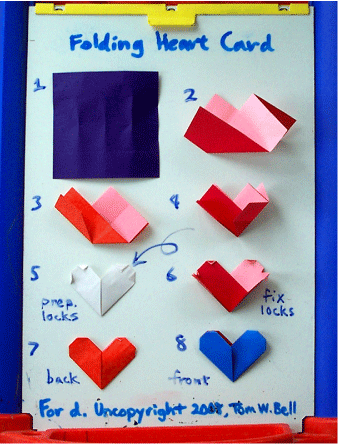
Here are some details:

If I might geek out for a moment, I'd like to offer some pertinent observations about copyright law. That I've uncopyrighted Folding Heart Card by no means guarantees that those who copy it will escape all liability. I have placed in the public domain only mywork of authorship—the image and the folds portrayed above. Another might claim copyright privileges over the same work, or some part of it. I claim Folding Heart Card as an original, but I must also admit that, by definition, unconscious copying remains a risk. So while I encourage you to copy the work as you see fit, and thereby honor both my love and your own, you must assume full responsibility for the outcome. I think, on net, you'll like the results.
Update: On his eponymous, conspiratorial blog, Eugene Volokh kindly cited my Valentine's Day offering. That prompted a question about the copyrightability of origami creations--and another excuse for me to geek out.
Origami works probably merit copyright protection under U.S. law as works of sculpture, though the constraints imposed by paper-folding (there are only so many ways to fold a heart, for instance) might support a merger defense to any such claim. The sequence of folds required to make a particular origami work, in contrast, would probably fall outside the scope of copyright, instead qualifying as a "procedure, process, system, [or] method of operation," per § 102(b). A patent would better suit that subject matter. An illustration of a folding sequence, such as my photos showing how to make the Folding Heart Card, would of course enjoy copyright protection.
As long as I'm updating, I'll also caution those of you who create the Folding Heart Card that its front does not open. The back does open up, however, once you unlatch the paper locks that hold it closed. If you prefer a version that will not tempt the card's recipient to try to open the front, you can, by way of a minor variation on the technique I illustrated, close its face with a kimono fold. I leave the details of that method, which I rejected as unappealingly unsymmetrical, as an exercise for students of origami.
[Crossposted to Intellectual Privilege and The Technology Liberation Front.]
Friday, February 08, 2008
The Packet-Switched Society
Two sharply contrasting views dominate the debate over copyright policy. On the one hand—the left one, we might say—copyrights represent mere policy tools, no better in principle than any other legal mechanism and, indeed, more modern, rationally planned, and democratically chosen that anything the common law can offer. On the other hand—the right hand, we might say—copyrights represent property rights no less than real estate or moveable goods do. On that view, copyrights deserve strict enforcement and our solemn respect.
[My draft book, Intellectual Privilege: Copyright, Common Law, and the Common Good, presents] copyright policy on a third hand. So grasped, copyright represents nothing better than a clumsy attempt to correct an alleged market failure. Common law rights, implemented by technological advances, social networks, and growing wealth, increasingly suffice to stimulate the production of original expressive works. Increasingly, we find that we do not need copyright. To that extent, it does us little good and much harm to remain imprisoned within the confines of the Copyright Act. Even if they wanted to, federal lawmakers could not put copyright policy into a delicate balance; they face powerful incentives to not even try. Better we should cast aside copyright's statutory privileges and rely on the common law to promote the public good.
Many people—well-informed, intelligent, and sincere people—will doubtless disagree with this third view of copyright policy. Many will have good reasons for doing so, too. Some, though, will have perhaps been mislead by their reliance on an older, less flexible understanding of copyright—what we might call a circuit-switched model. In fact, however, we can best understand copyright policy, and much else, by following the example set by packet-switched networks.
As courts and commentators traditionally describe copyright, it arises through the collective deliberation of central authorities who, after a delicate balancing of competing interests and in the name of the general welfare, create statutory rights to expressive works. In that model, lawmakers let copyright holders borrow the State's power to violate natural and common law rights, empowering copyright holders to control others' pens, presses, and voices. That approach strongly recalls the policy model applied to earthbound, closed, circuit-switched networks.
Those who build circuit-switched networks invoke the State's power of eminent domain to justify violating common law rights, laying wires that cut across private property. Regulators supervise the monopoly that results, imposing common carrier obligations, cross-subsidizing universal service, and controlling rates. So, too, goes the circuit-switched model of copyright: The Act empowers copyright holders to violate the common law, granting them statutory privileges that cut across customary rights, while lawmakers carefully calibrate the ebb and flow of expressions to maximize the general welfare.
This book takes a fundamentally different approach to public policy, an approach inspired by packet-switched networks like the market, person-to-person communications, and the internet. In such a network, message-bearing packets flow from point to point over any of many different paths, routed not according to the dictates of a central command but rather by generally accepted protocols. So long as a packet follows a few, simple rules, it can take any route it likes. Packet switching has many virtues; it often proves more flexible, robust, and scalable than circuit switching, for instance. It supports layer upon layer of complexity, too, encouraging a wealth of unplanned order. Most importantly for present purposes, packet switched networks offer us an apt model for understanding that vast web of consent-rich relations we call the liberal society.
Each of us a liberal society pursues a variety of goals, some shared and some unique. Each of us follows his, her, or (in the case legal persons) its own route through a network of voluntary ties. No central authority directs how we pursue our goals. Nor could it, given the complexity of the system and the distribution of information. Our packet-switched society instead relies on a few simple rules--based in natural rights and implemented through the common law--to define a protocol universally just and locally fair. Our society spontaneously generates peace and prosperity, the fruit of conscious action but not of conscious design.
As wire-bound parts of the internet demonstrate, a packet-switched network sometimes runs on a circuit-switched infrastructure. Similarly, liberal societies typically rely on some measure of State intervention to help patch the gaps where private means fail. But in neither case should we confuse an old fix for a necessary feature. Thanks to open-access and packet-switched radio communications, the Internet can—and probably should—escape from those circuit-switched bottlenecks so susceptible to disruption and censorship.
Similarly, common law now stands ready to finally cure the market failure that alone justifies copyright's statutory privileges. If thus rendered superfluous, the Copyright Act will turn from a necessary evil into simply an evil. We should not let that political kludge trap us within copyright's confines. Let us instead seek the common good in the common law.
[NB: The above text comes from the conclusion of my draft book, Intellectual Privilege: Copyright, Common Law, and the Common Good. You can find a PDF of the entire chapter, including footnotes, here. I welcome your comments.]
[Crossposted to Intellectual Privilege and The Technology Liberation Front.]
Thursday, January 17, 2008
Copyrights as Positive Natural Rights
[I earlier explained why copyrights do not qualify as natural rights under Locke's theory of property. Here, I explain why the same holds true under Barnett's positivist account of natural rights. Both passages come from my draft book, Intellectual Privilege: Copyright, Common Law, and the Common Good.]
Randy E. Barnett justifies natural rights conditionally, basing them on our appreciation of certain social goods. He emphasizes that "if we want a society in which persons can survive and pursue happiness, peace and prosperity, then we should respect the liberal conception of justice—as defined by natural rights—and the rule of law." Not everyone values freedom, harmony, and wealth, of course. Most of us do, though, and together we easily number enough to enjoy the comforts and pleasures of human society.
We live together amicably because we recognize and respect certain natural rights. Which ones? Barnett names private property—including our property rights in our bodies—and freedom of contract. Since property protects both the right to it and the right against trespass, it corresponds to common law's property and tort rules. Freedom of contract, which includes the right to contract and to not contract, corresponds to common law's contract rules. Barnett's description of natural rights thus matches the protections of persons, property, and promises at the heart of common law.
Barnett expressly includes "physical resources" in his description of property rights. "Such property rights are 'natural' insofar as, given the nature of human begins and the world in which they live, they are essential for persons living in society with others to pursue happiness, peace, and prosperity." Do copyright rights qualify as natural on that description? Probably not.
Barnett offers a positivist account of natural rights, an approach earlier developed by F.A. Hayek. Social values evolve and develop to enable human flourishing, Hayek explained. "[G]roups which happen to have adopted rules conducive to a more effective order of actions will tend to prevail over other groups with a less effective order," he said. That hardly means that groups with especially efficient rules conquer and crush their less developed neighbors. "It is more likely that the success of the group will attract members of others which then become incorporated in the first."
That competition between social orders spontaneously generated natural rights long before states arose. "Long before man had developed language to the point where it enabled him to issue general commands, and individual would be accepted as a member of a group only so long as he conformed to its rules," Hayek explained. David Hume expressed the same point with characteristic grace:
But tho' it be possible for men to maintain a small uncultivated society without government, `tis impossible they shou'd maintain a society of any kind without justice, and the observance of those three fundamental laws concerning the stability of possession, its translation by consent, and the performance of promises. These are, therefore, antecedent to government, and are suppos'd to impose an obligation before the duty of allegiance to civil magistrates has once been thought of.
Our rights to persons, property, and promises qualify as "natural" because they have evolved to enable human social life. They long predate the State. Copyright, in contrast, arose only relatively recently, in complete reliance on a non-customary, exceptional, statutory privilege.
[NB: The above text comes from chapter 2, § C.2 of my draft book, Intellectual Privilege: Copyright, Common Law, and the Common Good. You can find a PDF of the entire chapter, including footnotes, here. I welcome your comments.]
[Crossposted to Intellectual Privilege and The Technology Liberation Front.]
Friday, January 04, 2008
The Common Law from Satellite
[My forthcoming book spends a lot of time contrasting copyright with the common law. I thus thought that I should say at least a little about what I mean by the latter.]
[C]ommon law originates in custom, wins recognition in courts, and develops in commentary. Custom naturally comes first. It long ago gave rise to a set of social practices, such as avoiding bloodshed, honoring borders, and upholding oaths, that permit us to live in peace and prosperity. Referring to those and other customs helps common law courts to resolve our disputes justly. A judge might for instance determine reasonable conduct in a tort case by looking to community standards, award legal rights to someone who has long and openly used property entitled to another, or interpret a contract's language by light of trade usage. In these and other ways custom inspires—if not mandates—the common law. Commentators, looking back over many court decisions and across many years, help us to follow the common law's meandering path, explaining and rationalizing its wanderings. The common law thus develops from custom, through courts, and to commentary. [The below figure] illustrates.
[The above figure] traces the common law's origins from unarticulated customary practices, found in actions but not words, through the powerful speech of courts administering justice, to purely verbal commentaries on the law. Up to a point, then, the common law grows upward towards increasing abstraction over time; hence the initial upward cast of the arrows of influence laid out in [the above figure]. The forces driving the common law's development flow downward, too, though, toward more concrete results. Legal commentary sometimes persuades a judge, balanced on the cusp between two plausible claims, to choose one over another. Legal decisions sometimes affect customary practices, as when courts clarify that no person can own another. The threads of custom, court, and commentary thus intertwine, weaving over time the tapestry of common law. That offers a somewhat idealized picture, granted, and one far removed from the nitty gritty of real world litigation. What [the above figure's] satellite view of the common law lacks in detail, however, it makes up for in comprehension.
At its most basic and elegant, the common law comprises just a few, simple rules. "Aggress only in self-defense, do not trespass, and keep your word," it directs. Even more succinct: "Respect persons, property, and promises." We find it convenient and useful to follow those rules. They seem natural to us. They should; they evolved alongside us in the long journey from tribes, through kingdoms, and to states. They will doubtless continue to follow, and indeed promote, our social progress.
Rather than simply inventing it out of whole cloth, courts have helped to develop the common law by deciding how customary rules apply to particular disputes. In their collective wisdom, over hundreds of years, judges and commentators in Britain, the United States, and other common law countries have refined the principles of tort, property, and contract law. They have bequeathed to us a detailed set of time-tested and mutually compatible rules, well chosen to safeguard our peace and prosperity.
Nobody planned that happy outcome. The common law instead evolved spontaneously, developed over the ages and tested in countless conflicts, to protect our persons, property, and promises. Tort law, property law, and contract law do the heavy lifting. Beyond that, the core of common law, lies a variety of supporting sub-orders. We can fairly describe the rules of wills, trusts, and estates as a specialized part of the common law, for instance. Ditto the common law rules of agency and restitution. We find these, the rules of common law, initially in customary practices and then later in courts' decisions. Commentators, in treatises and restatements of the law, summarize, clarify, and systematize the common law's rules. By diligently studying those various sources we might discover the tort, property, contract, and other rules that together make up the common law. Notably, that effort will not lead us to copyright.
[NB: The above text comes from chapter 1, § II of my draft book, Intellectual Privilege: Copyright, Common Law, and the Common Good. You can find a PDF of the entire chapter, including footnotes, here. I welcome your comments.]
[Crossposted to Intellectual Privilege and The Technology Liberation Front.]
Wednesday, January 02, 2008
Copyright, Mapped
All copyrighted works originate as ideas, born when authors choose how to express themselves. The slightest exercise of discretion will suffice; just about anything more original than an alphabetical listing of names can qualify for copyright protection. Once having crossed that low hurdle, it remains only for an author to fix her expression in a tangible medium for more than a transitory duration. She must, in other words, record her authorship. After thereby fixing her work—in words, music, pictures, computer code, architecture, or almost any expressive medium—she enjoys the rights afforded by the federal Copyright Act. Copyright thus inheres both in doodles and multi-million dollar movies, in works ranging in creativity from formulaic news blurbs to unprecedented paintings.
Those, copyright's fundamental features, mark it as a distinct legal entity. Though laypeople often confuse copyrights with patents, trademarks, and other intangible goods, each of those related types of IP corresponds to a unique combination of subject matter and supporting law. [The figure below] illustrates how copyright relates to, and differs from, its nearest legal next-of-kin.
Rather than the points of a compass, [this figure] charts several legal dimensions. The left vertical scale divides IP into two fundamentally different categories. IP above the horizontal divide, such a trademark, has value only insofar as it helps to identify other things of value. Below the divide, in contrast, falls intrinsically valuable subject matter. Ask yourself which type of IP you would want on a desert island; those you would choose fall into “valuable per se” territory. The right vertical scale shows the source of a legal protection. Towards the middle lies state common law, farther out lies state statutory law, and at the extremes lie federal statutory law. Unfair competition straddles all three categories, for instance, whereas copyright depends entirely on federal statutory law. The bottom horizontal scale indicates to what degree a particular kind of IP protects expressive or functional subject matter. Copyright stretches from poems to computer programs, for instance, whereas trade secret covers only commercially useful ideas.
The arrows on the map indicate how rights develop over time. Each sort of IP begins as an idea. From there, different types of IP move in different directions, depending on their subject matter. As a general matter, as the arrows move away from the center of the map, rights grow: more developmentally mature; more powerful; harder to obtain (because the requirements for protection become more stringent and formal); and more public and federal. Copyrights, however, moves relatively quickly and easily from mere ideas to full federal protection.
Figure [[cite]] shows two possible precursors to copyright: common law's protection of literary property or state 's statutory protection of unfixed expressive works. The former legal right expired as of January 1, 1978, when the Copyright Act preempted it, and appears here solely as a historical marker. The latter legal right has won general recognition in California, which offers copyright-like protection to unfixed works of authorship, and narrower protection in New York, which has enacted criminal sanctions on fixing a public performance without permission and with the intention of profiting therefrom. In most cases, therefore, ideas now speed directly to copyright protection without making any intermediary legal stops.
Notably, [the figure above] does not include what some courts and commentators have called "common law copyright." As the Supreme Court established long ago, no such thing exists. The common law's protection of expressive works traditionally applied only to unpublished works; it did not give authors anything like copyright's exclusive publication rights. [The above figure] thus eschews "common law copyright" as a misleading label.
The protean nature of the common law admits other interpretations of its scope, granted. New York courts have in recent years created—"recognized" would overstate the case, given that the courts did not claim to uphold any customary practice—a common law right against the unauthorized duplication of publicly-distributed sound recordings made prior to February 15, 1972, the date on which federal copyright protection first extended to such works. The decisions of only one state's courts hardly suffice to define the common law, however, especially when all other states to consider the question have reached a contrary conclusion. It remains a bit cloudy whether the common law's protection of literary property extends to unfixed works, too; several courts have denied that it does while some courts have hinted at a broader right. Here as generally, it seems wisest to attribute to the common law only those rules that have won express and wide approval.
[NB: The above text comes from chapter 1, § B of my draft book, Intellectual Privilege: Copyright, Common Law, and the Common Good. I will soon upload a PDF of the entire chapter, including footnotes. I welcome your comments.]
[Crossposted to Intellectual Privilege and The Technology Liberation Front.]
Wednesday, December 26, 2007
Copyright's Path
Works of authorship originate in private, safely kept under common law protections. Once published, however, expressive works become data ferae naturae—wild and natural information. As such, expressive works roam and reproduce freely. They may get captured in fixed copies, caged in atoms or bits. But the public, once it has absorbed an expressive work, generally retains relatively cheap access to it—unless and until copyright intervenes.
Copyright law limits public access to expressive works, herding them off the commons and into private hands. The Copyright Act offers a sort of ranch to authors, giving them a place to birth, raise, and sell their expressive works safe from the deprivations of grasping strangers. Authors enjoy those special privileges against the public not as a natural right, but rather solely thanks to a policy authorized by the U.S. Constitution and implemented through the Copyright Act. [The figure below] illustrates the path that copyright, together with some of its legal next-of-kin, takes from its origins towards its goals.
Expressive works begin as toll goods, excludable but non-rivalrous in consumption. In other words, an author can at first keep others from consuming her expressions thanks merely to her common law tort, property, and contract rights. She can keep her works in private, under lock and key, releasing them only upon solemn promises of secrecy. Those with whom she shares her work can enjoy it without at all decreasing her enjoyment of the same work; she can sing her song or study her painting just as well if others listen to or gaze on their own copies. That marks her work, like other works of authorship, as non-rivalrous in consumption. It retains that characteristic if and when she publishes the work, but then loses its excludability. Unless she were to somehow form and enforce a contract with everyone who encounters her published work—an unlikely prospect—only through copyright law could she protect her work from unauthorized access. Copyright steers published works back into toll good territory, empowering authors to assess fees and impose other limits on those who would use their works.
The Copyright Act's privileges, because they restrict non-authors from freely copying a copyrighted work, defy natural and common law rights. That statutory negation of erstwhile public goods, however, arguably serves the public good. Though copyright restricts access to existing works of authorship, it encourages new ones.
[NB: The above text comes from chapter 1, § A of my draft book, Intellectual Privilege: Copyright, Common Law, and the Common Good. I will soon upload a PDF of the entire chapter, including footnotes. I welcome your comments.]
[Crossposted to Intellectual Privilege and The Technology Liberation Front.]
Tuesday, December 25, 2007
Discouraging Just Enough Infringement
While rightly shuddering at specter of copyism, we should also recognize that the unauthorized use of copyrighted works can, if it does not go so far as to undercut authors' incentives, increase social wealth. Consider, for instance, an impoverished entrepreneur relying on pirated software to start her business. Supposing that she could not afford to buy an authorized copy, and that her unauthorized use would not depress software production, her infringement would generate a welcome consumer surplus. The same would hold true of, say, someone who enjoys an infringing copy of a CD despite being unwilling to pay its retail price. As [the figure below] illustrates, those exceptions to the strict enforcement of copyright law could in theory benefit us all without discouraging the production and distribution of expressive works.
[The above figure] surely offers too sanguine a view of the effects of copyright infringement, however. Without the limitations imposed by copyright law, some consumers who would otherwise willingly pay for authorized uses might instead opt to save their money by joining the unpaying masses of unauthorized users. The resulting exodus, from respecting copyright to infringing it, would risk decreasing the revenues afforded by copyright, bringing about the policy tragedy portrayed [earlier].
How does copyright law dispel that, the specter of copyism? By imposing high marginal costs on infringing uses of protected works. Absent the Copyright Act, and especially in digital works, an infringer would generally face the same low marginal reproduction costs as a copyright holder. Thanks to the Copyright Act, an infringer might have to pay actual or statutory damages, lost profits, costs, and/or attorney's fees to a copyright holder for every unauthorized use.
How high should lawmakers set the marginal costs of infringement? We wouldn't want them to under-deter it, lest the specter of copyism become all too real. Nor would we want them to overdo it, given that a modest level of infringement can deliver social gains. Theory suggests that lawmakers should set the marginal costs of infringement, taking into account that only some infringing uses get caught and litigated, just high enough to ensure that authorized users will have no incentive to opt for paying less than enough to sustain authorship. [The figure below] illustrates.
So, at least, goes copyright in theory. In practice, as discussed in chapter 4, lawmakers lack both the information and incentives to calibrate copyright policy so precisely. These economic models thus only explain how copyright law should work—not how it does work.
[NB: The above text comes from chapter 1, § C.3 of my draft book, Intellectual Privilege: Copyright, Common Law, and the Common Good. I will soon upload a PDF of the entire chapter, including footnotes. I welcome your comments.]
[Crossposted to Intellectual Privilege and The Technology Liberation Front.]
Monday, December 24, 2007
The Specter of Copyism
On the standard economic view of copyrights, as on the economic view of other monopolies, average revenue equals demand. Those two measures trace one and the same line. Why? Because for most products and services, consumption closely matches supply at the market-clearing price. Sales reveal consumer demand and, in the case of copyright and other supposed monopolies, only one seller reaps revenue from those sales. Thus, for instance, might a utility's sales show the aggregate consumer demand for electric power.
Even a so-called monopolist might face competition, however. The sole authorized seller of hard liquor might fail to capture the entire market of drinkers, for instance, losing some to the resale of stolen goods and others to moonshine. So, too, might an electrical utility suffer theft, competition from home-brewed power, and exit to gas appliances.
The caveats to "monopoly" prove especially strong in the case of copyright, which permits some unauthorized uses of protected works, such as fair uses, and fails to prevent many infringing uses. We might fairly say that the former category of uses, because copyright holders have no statutory power to bar them, do not really cut into the market share for a copyrighted work. Copyright holders cannot lose what never have, on that view. I here thus focus on infringing uses. Still, though, it bears noting that, whether due to permitted or forbidden uses, a copyright holder never commands all of the market for an expressive work.
That conflict between theory and facts shows why we should perhaps eschew speaking of "the copyright monopoly" and instead talk about copyright in terms of market power. Whether or not it hands out monopolies, after all, the Copyright Act does give a powerful subsidy to those it protects: the privilege of invoking State power to inhibit infringing uses of expressive works. The standard economic model of copyright usefully captures that effect, but somewhat exaggerates it. We can get a more accurate picture of copyright by splitting consumer demand from average revenue.
The consumption of an expressive work—and thus the revealed demand for it—may greatly exceed the supply legally permitted under copyright law. Effectively, some consumers treat copyrighted works like public goods, paying only very low marginal costs of reproduction. That payment typically comes not in cash but in the opportunity costs, in terms of time and effort, of copying. At all events, none of it goes to copyright holders, leaving them aggrieved and, sometimes, litigious. But copyright holders seldom find it worthwhile, or even possible, to fully defend their rights under the Act. Many infringing acts go undetected or for other reasons elude enforcement. [The figure below] illustrates that phenomenon, showing how in the case of a copyrighted work aggregate consumer demand might diverge from the copyright holder's average revenue..gif)
Copyright holders understandably object when, due to infringement, they earn less revenue than the law entitles them to. But why should the rest of us care? Recall that copyright aims to cure a looming market failure: we will suffer an undersupply of expressive works if authors cannot recoup their production costs. Copyright aims to cure that failure by giving authors the privilege of controlling, and thus profiting from, certain uses of their works. Infringement threatens to upset that statutory mechanism, depriving authors and their transferees the revenues necessary to stimulate the production and distribution of expressive works.
We might call that threat, after Marx and Engels, "the specter of copyism." And, as the allusion to communism suggests, we should all worry that poverty will follow if production does not pay. In the case of copyright policy, in other words, we should worry that infringement will decrease copyright holders' revenues below the level necessary to sustain authorship. As [the figure below] illustrates, that threatens to deny the market new expressive works.
[NB: The above text comes from chapter 1, § C.2 of my draft book, Intellectual Privilege: Copyright, Common Law, and the Common Good. I will soon upload a PDF of the entire chapter, including footnotes. I welcome your comments.]
[Crossposted to Intellectual Privilege and The Technology Liberation Front.]
Sunday, December 23, 2007
The Standard Economic Model of Copyright
Creating a work can cost authors a lot, whereas copying a work costs others very little. Absent copyright, then, authors might find it discouragingly difficult to recoup the costs of creating fixed expressive works. Authors might then underproduce expressive works, and the public consequently suffer.
To avoid that policy tragedy, the Copyright Act empowers authors to control the reuse of their fixed expressive works. By selling those special statutory privileges, authors can offset their production costs. Thus does copyright arguably do what the common law allegedly cannot: ensure that the public enjoys an adequate supply of expressive works.
The benefits of copyright policy come at a price, however. Although it may cost a great deal to make the first copy of a fixed expression, it usually costs very little to make and distribute subsequent copies. Absent copyright protection, those works would constitute public goods. Copyright bars the public from freely enjoying the very goods labeled "public." Instead, the Act vests copyright holders with the power to charge whatever the market will bear to escape liability for infringement. Though the monopoly rents that copyright holders thereby win allegedly provide a necessary stimulus to creativity, non-holders suffer the opportunity costs of losing cheap access to fixed expressive works. Most commentators thus understand copyright policy to aim at striking a balance between giving authors sufficient incentives to create expressive works and providing the public with adequate access to the works thereby created. [The figure below] illustrates that, the standard economic model of copyright policy.
As portrayed in [the above] figure [], an author incurs large costs upon creating a fixed work but very low marginal costs of production (MC) thereafter. The author's average costs of production (AC) thus drop with each additional copy she—or, more likely, the party to whom she sells her copyrighted work—produces. She faces the usual sort of downward-sloping aggregate demand curve (D), which also marks the average revenue (AR) she can make by selling any given number of copies. How many should copies should she sell? Were social efficiency the test, she would sell the quantity (Qe) corresponding to the point where her marginal cost curve crosses the demand curve, earning the corresponding price (Pe). But that would discourage her (and other would-be authors) from creating fixed expressive works, as it would not allow her to recover her average costs. For her to break even in the authorship business, she would need to sell at least the quantity (Qs) corresponding to the point where her average cost curve crosses the demand curve, thereby earning a sustaining price (Ps). Happily for her, though, the monopoly privilege afforded by copyright law allows her, at least in theory, to sell even fewer copies, and at a higher price (Pm). Specifically, she will want to sell a quantity (Qm) that corresponds to the point where her marginal revenue (MR) curve crosses her marginal cost curve. At higher quantities than that, her marginal costs would exceed her marginal revenues, giving her marginal losses. If our hypothetical author manages to sell at the monopoly quantity and price that maximizes her benefits, she will earn profits (OP) equal to the amount her revenue exceeds the amount necessary to recoup her average costs. In that event, consumers to whom she sells will enjoy a surplus (CS) representing the different between what they pay and how much they value her work. Non-holders unwilling to pay what she demands, however, will suffer opportunity costs (NO) equal to how much they would have paid for the uses barred by her assertion of copyright.
We could doubtless say more about that, the standard economic model of copyright, adding complications, quibbles, and criticisms. I will, below, in explaining why we stand a good chance of outgrowing copyright. For now, though, let us assume that [the above] figure [] offers a conventional and useful economic model of copyright.
[NB: The above text comes from chapter 1, § C.1 of my draft book, Intellectual Privilege: Copyright, Common Law, and the Common Good. I will soon upload a PDF of the entire chapter, including footnotes. I welcome your comments.]
[Crossposted to Intellectual Privilege and The Technology Liberation Front.]
Subscribe to:
Posts (Atom)