Originalism--the theory that we should Interpret the Constitution according to the public meaning of its words at the time of its ratification--serves important instrumental goals. It promises to give relatively clear and objective definitions to crucial but contestable terms, such as “cruel and unusual” or “due process of law,” by recurring to the linguistic usage of those who ratified the Constitution. That interpretive process, though hardly easy, at least protects us from the sort of judicial casuistry that threatens to drain all fixed meaning from the Constitution’s words.
To praise originalism for relative certainty and objectivity is not to say that its definitions always comport with our own, however, or that they hold constant from one place in the Constitution to another. Consider “cruel and unusual,” for instance. So long as they do not lapse into what Scalia called a “faint-hearted” devotion to principle, originalists must admit that it is not unconstitutional to publicly flog or brand criminals. Originalism thus gives us a very clear answer, and one untainted by any contemporary bias (indeed, entirely divorced from modern sensibilities), to the question of what “cruel and unusual” means. It may not be quite the answer the average person—or the average criminal—expects, but originalism does not pretend to play to the crowd.
Nor does originalism, despite its certainty and objectivity, always give words consistent interpretations. In the case of “due process of law,” for instance, originalism suggests that a different meaning applies each of the two times the phrase appears in the Constitution. Why? Because each such appearance dates from a different ratification process, in a different era, in which “due process of law” meant different things. Perhaps it would not be fair to thereby criticize originalism for inconsistency on that count; the same interpretative process applies to each appearance of “due process,” after all. But it does drive home the point that originalism does not care about reading the Constitution in the same way that an ordinary subject, using ordinary English, would read it today.
Originalism has another instrumental virtue: It tends to generate such substantively attractive results as limited government, the rule of law, and respect for individual rights. For that, we can credit not just the sound political judgments of the Founders but also, and more generally, the supermajoritarian constraints imposed on Constitutional ratification. Because the ratification process has to satisfy so many parties, who have many conflicting interests, the Constitution and its amendments tend to support universal values. Contemporary judges, because they do not face those similar constraints, risk following the twists and turns of case law toward unlimited government, arbitrary laws, and disregard for individual rights. Originalism, by recurring to the Constitutional meanings that won ratification, offers a way (though not the only or necessarily best way) to stave off that ugly outcome.
[The above comes from my forthcoming paper, Originalism and the Consent of the Governed: A Critique and a Cure, which I’ve submitted for presentation at the Third Annual Originalism Works in Progress Conference.]
Friday, September 02, 2011
What is Originalism Good For?


Friday, August 12, 2011
Volokh on the Constitution's Plain, Present, Public Meaning
My friend, Eugene Volokh, has posted some thoughtful comments on my consent-based approach to reading the Constitution. His excellent questions show one benefit of looking for the plain, present, public meaning of the Constitution: It gives us a fresh look at a document we risk treating as putty for judges or as a dead historical artifact.
I won't pretend that a consent-based approach to reading the Constitution solves all our interpretive problems--especially hard problems like those Eugene raises--but every theory struggles with the text. Looking for the plain, present, public meaning of the Constitution offers at least another way to tackle the problem. I'd argue, further, that it offers us the best way to maximize the consent of the governed.
Eugene cites a "number of terms that either don’t have a 'plain, present, public meaning' apart from either their originalist or precedential meaning," such as those in the First Amendment or other, well-known parts of the Constitution. I appreciate that observation--though again I emphasize that precedent-based "living" constitutionalists and originalists struggle with the same passages. I won't bother, here, to try to answer each puzzle that Eugene offers, as I am more interested in describing a methodology than I am in dictating particular results. I have opinions about such things, to be sure, but I'm no judge.
How should real-world judges interpret constitutional words or phrases that the public understands to have a specialized meaning (e.g., "establishment of religion") or no discernible meaning at all (e.g., "writ of habeas corpus")? The same way they would interpret and construct a contract in similar circumstances: interpreting legal terms as such, taking heed of their context, and constructing uncertainties against the drafting party (the U.S. federal government, here) and in favor of the adhering party (citizens and residents of the U.S.).
That does not lead to simply following Supreme Court precedents. I doubt that Kelo would come out the same way under that approach, for instance, nor that "Property" would end up with a different meaning each time it appears in the Constitution. Note, too, that the approach I describe leaves room for considering original meaning, which we should treat as something akin to "course of dealing" in the contract context. By borrowing the methodologies of contract law, a court can come as close as possible to finding the plain, present, public meaning of popularized constitutional phrases and uncommon terms such as "writ of habeas corpus." Perfection remains elusive, here as with other approaches to the Constitution. But this approach offers the best guarantee of preserving the consent of the governed.
Thursday, August 11, 2011
The Hard Question
Consent to constitutional governance varies by degrees and from person to person. Different levels of consent give different levels of justification. The hard problem is justifying the use of political violence against someone who expressly objects to it.
We respect the right to defend against a tort even absent the tortfeasor's express agreement, true. Everyone impliedly consents to the fundamental principles of tort law; they offer background rules for human conduct on which all socialized people depend. Our implied consent to tort law counts for a lot. It trumps merely hypothetical consent to the contrary, for instance. Some people offer fancy theories about that to which we would consent (usually something that benefits them). The implied protections of tort law trump such arrogant presumptions.
How, then, can a statist justify initiating coercion? Note that tort law boasts only a moderately powerful justification--one founded on implied consent. Express consent has greater power to justify. Therefore, the implied consent justifying tort law gives way before express consent, as when sparring partners tap fists before attacking each other. (Funny thing I've noticed about the BJJ studio I frequent: Lots of fighting; smiles all around.)
Have we expressly consented to constitutional governance? Some individuals undoubtedly have, such as those who have sworn oaths to uphold the Constitution. Perhaps run-of-the-mill citizens and residents show their implied consent to the authority of the U.S. federal government simply by not emigrating. And eloquent arguments have been made that the Constitution, if interpreted well, merits our hypothetical consent. See, e.g., Randy Barnett on the presumption of liberty.
Against those measures of consent, we hear polls suggesting that "consent of the governed" has fallen to a new low. We hear strong arguments that mere residency implies nothing about political allegiance, and philosophical claims that nobody would agree to a system of institutionalized coercion.
Consent weighs on both side of the scale measuring the justification of constitutional governance, both for and against. I cannot answer for anyone else about justifying the Constitution; you must answer for yourself. But with graduated consent theory, I offer you a way to tackle the question.
(With thanks to Sasha Volokh for stimulating discussion.)
Tuesday, August 09, 2011
Original Meaning v. Consent of the Governed
At the Constitution's ratification, original meaning and consent coexisted. But with the advent of a new generation, the Founder's consent faded and died. To justify constitutional governance of the living requires the force of their living consent.
How can we win the consent of the governed? Only imperfectly, to be sure. The Constitution is not a contract. But we can best justify it by reading it as if it were a contract. More specifically, we should regard it as a standard form adhesion contract offered by the federal government to prospective subjects. The feds don't offer a terrible deal, as such things go. Those who attended the ratification debates accepted the offered Constitution, after all. But their choices do not very well bind us--not, at least, if justification relies on consent.
A court interpreting a standard form agreement would adopt the same approach. Suppose, for example, that Hertz first rolled out its standard form contract in 1953. Among other things, the contract said Hertz would provide a "safe" vehicle. The new contract was proposed to many various consumers and won the assent of many, thus bringing it into effect. But Hertz cannot cite that ratifying consent as binding on me; it must win my assent anew. And any court worth its salt will, if asked to interpret the contract between Hertz and me, inquire as to the public meaning of the words as of when I signed. Hertz cannot, in other words, cite the original meaning of the contract to try to fob off on me a car that has no seatbelts. That might have been "safe" in 1953, but it is not within the reasonable public meaning of the word, now.
By extension, we should reject Scalia's claim that the Constitution today permits public flogging because that would not have been considered among the "cruel and unusual punishments" banned by the 8th Amendment at the time of its ratification. Instead, we should look for the plain, present, public meaning of those constitutional terms. We--and not the long-dead founders--face the lash. therefore our consent--or lack thereof--should control.
(Justification does rely on consent, by the way, but the relationship is not a black-and-white one. See, Graduated Consent in Contract and Tort Law: Toward a Theory of Justification, 61 Case Western L. Rev. 17 (2010). If you're in a rush, you can find a slightly earlier version, download-ready, here.
Monday, August 08, 2011
The Constitutional Meaning of “Property” and the Rule of Law
Although the U.S. Constitution uses “Property” four times, it nowhere defines the term. What does it mean? I’ve been grappling with that question this summer, and been surprised to find commentators and cases arguing that “Property” counts as different things in different places. On some accounts, for instance, the word means only land in Article IV, § 3, general common law property in the Takings Clause, and all that plus welfare entitlements in the Fourteenth Amendment’s Due Process Clause.
Giving constitutional property so many different definitions threatens the rule of law. An average citizen, using ordinary English, would not likely read “Property” to stand for something different each time the word appears in the Constitution. Yet both leading theories of constitutional interpretation—originalism and “living” constitutionalism—invite that sort of confusion. Both theories avow that the meaning of "Property" or another constitutional term can change from place to place because of historical accidents (in the case of the former) or Supreme Court decisions (in the case of the latter).
I thank my friend and fellow law prof, Eugene Volokh, for discussing some of these matters in an extended email exchange. He recently quoted some of his thoughts about how constitutional words—he uses “Place” and “Law” as examples—can change depending on context. He makes sound observations. In fact, I'll go Eugene’s examples one better. Consider the word, "it," which means "House" in Art. § 5, "Bill" in Art. I, § 7, cl. 2, "Writ of Habeas Corpus" in Art. I, § 9, cl. 2, "State" in Art. I, § 10, cl. 2, and so forth.
We should expect such semantic flux if, as Eugene rightly says, the Constitution is written in ordinary English. Query, though, whether the four appearances of "Property" in the Constitution appear in contexts that give it four (or even, on one accounting, five!) distinct meanings. I think not, though I remain open to persuasion otherwise.
Eugene's observations do nothing to save originalism or living constitutionalism from the charge that they offend the rule of law, however. The rule of law does not suffer if we read words in their constitutional context because ordinary speakers of ordinary English can figure out that “it” means "House" in one place and "Writ of Habeas Corpus" in another. But originalism and living constitutionalism raise a different problem, given that they base constitutional meaning on historical usage (in the first instance) or Supreme Court precedents (in the second). Only specialists in constitutional law—and not even all of them—have the expertise to engage in that sort of decoding process. Did you know, for instance, that “Property” includes government entitlements in the Fourteenth Amendment but not in the Fifth? If so, I doubt you figured it out from reading the Constitution, alone.
How do we fix this problem with both originalism and living constitutionalism? By rejecting those theories for one that gives the Constitution’s text its plain, present, public meaning. For more, see my paper, Graduated Consent in Contract and Tort Law: Toward a Theory of Justification, 61 Case Western L. Rev. 17 (2010), a slightly revised version of the download-ready, Graduated Consent Theory, Explained and Applied, Chapman University School of Law, Legal Studies Research Paper Series, Paper No. 09-13 (March 2009) [PDF format].
Ratification may be necessary to make a Constitutional term effective in the first place, but it is not sufficient to make an original meaning binding on subsequent generations. People today, using ordinary English, almost certainly regard public flogging as unconstitutionally cruel and unusual punishment. In contrast, Justice Scalia has argued that an originalist (such as himself) should (and does) regard public flogging not as unconstitutional but simply, "stupid." That he can offer so tepid a criticism of something almost any citizen would regard as beyond the pale demonstrates the salient gap between an originalist approach and a consent-based one. (Living constitutionalism's abuse of ordinary English makes it susceptible to a similar critique.)
Monday, January 10, 2011
It the Constitution True?
Just because the Founders ratified a Constitution as they understood it does not mean that we ratify one with the same meaning. We ratify our Constitution, as we understand it, or not. We cannot justly be bound by others' choices.
Consider the Constitution as might a philosopher of language, asking, "Is the preamble's claim about ordaining and establishing the Constitution true?" The easy answer is, "Yes, it was made true by the ratification of at least nine state conventions." That looks like as near a truism as history can offer. But does that same preamble hold true today? The answer depends on whether we the present people ordain and establish the Constitution.
Suppose, by way of thought experiment, that a meteorite struck the nascent U.S., wiping it out but leaving documentary evidence, such as the Constitution, abroad. An Englishman reading that Constitution after the disaster would observe, "Yes, they did ordain and establish that Constitution. But it nowhere survives, today. The Constitution died in that huge gaping crater that was once the United States. Taken in the present-tense, the Constitution lies. We can understand it only as a historical artifact." Less dramatically, the same would hold true if everybody in the U.S. suddenly decided that it just wasn't worth the trouble, and magically gave up the collective hallucination of a federal government. Unless we keep it alive with our consent, the Constitution means nothing more than an account of what once was.
The choice boils down to this: If you rely solely on original meaning, you will ordain and establish a Constitution that was. If you want to ordain and establish the Constitution for we, the living People, you have read it through living eyes.
Monday, June 28, 2010
Barbie, Political Philosopher
Toy Story 3 offers many pleasures and not a little wisdom. I absorbed them with a shocking output of tears, both the laughing kind and otherwise. At one point, too, I raised my fist in solidarity, moved by the political philosophy voiced by Barbie (brilliantly played by Barbie). I liked Barbie's quote so much that I put it on a t-shirt:

Nice, huh? Click on the picture to customize the shirt for your build and style.
Fellow Bluebook geeks will notice that, despite its graphic fripperies, the shirt sports a proper legal citation. Scholars might take comfort in the fact that I crosschecked the quote against the junior novel version of Toy Story 3. Lawyers for Disney/Pixar must admit that my usage falls within the traditional bounds of the fair use defense to copyright infringement, and Hasbro cannot justly complain that the shirt's use of "Barbie" violates that trademark.
Tyrants might not like the shirt, granted. But Barbie showed us what happens to tyrants. I won't say more about that, here; just go see the movie!
UPDATE: Notwithstanding law and logic, Zazzle.com pulled the shirt almost immediately after I posted it for sale. I'm currently trying to correct the matter. Sorry for the inconvenience.
[Crossposted at Agoraphilia and The Technology Liberation Front.]
Friday, March 27, 2009
The Transcendental Value of Consent
Consent plays a prominent role in moral reasoning. I here offer a new, transcendental argument for the moral value of consent: Because an attempted justification aims, by definition, to obtain its audience's consent, justifications presume the moral significance of consent.
Students of philosophy tend to associate transcendentalism with Immanuel Kant, who argued against metaphysical skepticism on grounds that reason necessarily presumes both time and substance. Kant had no monopoly on "transcendental," however, which simply describes a particular form of argument. A transcendental argument begins with an uncontroversial fact, adds a proposition that necessarily follows from that fact, and concludes in support of the proposition. Following that form, the transcendental argument for consent's moral relevance runs as follows:
1. A justification aims to win the consent of its intended audience.
2. If a justification aims to win the consent of its intended audience, then the argument's efficacy covaries with the consent of that audience.
3. Therefore, justification presumes the value of consent.
This argument for consent's moral relevance begins with a (supposed) truism about the nature of justification. Readers who regard step one as an obvious truth can skip to step two without delay. Some might doubt its truth, however; in particular, a skeptic might counter that justifications sometimes aim to mislead their intended audiences, as when political leaders conspire to mislead gullible citizens about the causes of social unrest, blaming foreign provocateurs rather than native disaffection. In such a case, however, we cannot properly say that the justification aims to win the consent of the governed; it aims, rather, to win their ignorant acquiescence.
The claim made in step two of the transcendental argument for consent's role in justification might, like the claim made in step one, strike many readers as obvious. As long ago as Aristotle, philosophers have regarded the end, or teleos, of a thing as a fair gauge of its proper function. On that reasoning, if a justification (or, more properly, the person offering the justification) aims to win the consent of a particular audience, we can judge whether or not the argument succeeds by measuring the consent that the argument rouses.
The third step of the argument for the moral relevance of consent follows as a matter of logic from the first two steps. Even hardcore skeptics do not trouble themselves challenging modus ponens, so perhaps we could stop here. As a safeguard against sophistry, however, let us double-check whether the argument's conclusion—that justification presumes the value of consent—conforms with common sense.
Note, first, that an argument nobody accepts cannot work as a justification. We thus laugh off the arguments, no matter how internally consistent or ardently pressed, a madman makes when he claims the right to rule the Earth. Because his argument wins nobody's consent, nobody regards it as sufficient justification for his coronation. Note, next, that we commonly regard informed consent as adequate justification for imposing far-ranging conditions on those who accept them; we hesitate to second-guess another's pursuit of happiness. Lastly, note that we tend to recognize exceptions to that rule only in defense of consent itself, as when we refuse to enforce an agreement to submit to slavery, when we deny the power of fraud to justify a transaction, or when, far from praising a mugger for successfully inducing his victim to give up her purse in exchange for not losing her life, we condemn his acts as coercive and unjustified. Logic and experience alike thus suggest that we judge an attempted justification in terms of whether or not it wins the consent of its intended audience. Unsurprisingly, the plain meaning of "justify" conforms to that understanding.
[NB: The foregoing comes, after various edits, from Part I.B. of Graduated Consent Theory, Explained and Applied, Chapman University School of Law, Legal Studies Research Paper Series, Paper No. 09-13 (March 2009) [PDF].]
Wednesday, March 18, 2009
A Call for Citizen Courts
It stands as a fundamental principle of justice that we cannot entrust one party to unilaterally judge its disputes with other parties. This poses a problem for the resolution of disputes between a State and those subjected to its legal jurisdiction. How impartially can agents of the State, acting as the judges of its courts, decide such disputes? "Not well enough," citizens and residents might worry. It thus looks at least unwise, and arguably unjust, to give federal authorities exclusive jurisdiction over disputes that call for applying the U.S. Constitution.
If we view the U.S. Constitution as a contact—a standard form agreement offered on a take-it-or-leave-it basis by an awesomely powerful government to a comparatively powerless individual—we cannot help but note the glaring inequity of letting only federal authorities decide questions of federal power. No just court would enforce a standard form agreement between grossly unequal parties, imposed by one on the other under conditions that raise serious doubts about the offeree's consent, that lets the all-powerful offeror alone decide disputes arising under the agreement. A clause reading, "I have the sole power to interpret this agreement," reeks too much of substantive unconscionability to win a court's approval. Indeed, the patent unfairness of such a clause cannot help but raise procedural doubts about whether the parties bargained for an exchange at all, undermining the enforceability of the entire agreement.
Happily, we can easily read the U.S. Constitution to avoid the vice of self-judgment. Its plain text by no means mandates that only federally employed judges can decide the scope of federal power. . . . We thus remain at complete liberty to adopt this remedy for self-judgment: Decide disputes between the federal government and other parties under the same arbitration procedures that private parties customarily use in deciding their contractual disputes. In other words, we should establish Citizen Courts.
A Citizen Court would arise at the option of any party to a legal dispute with the federal government being heard by a federal court. Each party—including the federal one—would choose one judge. Those two judges would then agree on a third. Together, the panel of three judges would decide the parties' dispute. Rather than leaving questions about the power of the federal government solely in the hands of federal agents, therefore, a Citizen Court would rely on judges to which the disputants have consented. A Citizen Court would help to remedy the partiality of federal courts and, thus, would offer more justifiable judgments.
[NB: The foregoing comes, after various edits, from Part III.B.3.c. of Graduated Consent Theory, Explained and Applied, Chapman University School of Law, Legal Studies Research Paper Series, Paper No. 09-13 (March 2009) [PDF].]
Sunday, March 15, 2009
Original Reasons for Non-Originalism
Although some of my closest friends might respond with expressions of fury and disappointment, I am coming out of the closet on originalism. I am not convinced that we should interpret the Constitution's text to mean what those who ratified it thought it meant, over 200 years ago. Instead, I think we should favor the plain, present, public meaning of the Constitution's text, resolving any ambiguities in favor of individual liberty.
Given the popularity of originalism among self-proclaimed libertarians and conservatives, my view risks raising some hackles among the very people with whom I so often agree in questions about the constitutional limits on government action. So be it. Originalism's foundations have always seemed pretty shaky, to me, even though I usually like the theory's results. It has taken me some years to formulate a different, and I think much more solid, foundation for resolving questions of constitutional meaning. I describe that new approach in a working paper, Graduated Consent Theory, Explained and Applied, Chapman University School of Law, Legal Studies Research Paper Series, Paper No. 09-13 (March 2009) [PDF]. For a snapshot view of the theory, consider this figure from the paper: 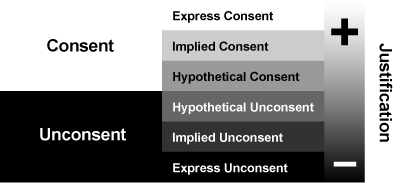
That may look familiar, given that I earlier blogged about The Scale of Consent, a working paper that, in revised form, constitutes one part of this larger paper. Rest assured, though, that this later work has a different, and more ambitious goal. Here is the abstract:
We often speak of consent in binary terms, boiling it down to "yes" or "no." In practice, however, consent varies by degrees. We tend to afford expressly consensual transactions more respect than transactions backed by only implied consent, for instance, which we in turn regard as more meaningful than transactions justified by merely hypothetical consent. A mirror of that ordinal ranking appears in our judgments about unconsensual transactions. This article reviews how a wide range of authorities regard consent, discovering that they treat consent as a matter of degree and a measure of justification. By abstracting from that evidence, we can outline a theory of graduated consent. This article concludes by testing a graduated consent theory against such problems as enforcing standardized agreements, justifying political coercion, and reading a constitution. In those and other applications, a theory of graduated consent can help to advance legal, moral, and economic reasoning.
If I don't sidelined by other, more pressing obligations, I'll post here some excerpts from Graduated Consent Theory. It offers a number of original (but not originalist!) arguments, which I'd like to air for commentary. I plan to publish the paper in a law review and want to make sure the best possible version makes it into print.
Thursday, January 01, 2009
The Scale of Consent
I recently posted to SSRN a working paper, The Scale of Consent, a copy of which you can download here. Here's the abstract:
We often speak of consent in binary terms, boiling it down to "yes" or "no." In practice, however, consent varies by degrees. We tend to afford expressly consensual transactions more respect than transactions backed by only implied consent, for instance, which we in turn regard as more meaningful than transactions justified by merely hypothetical consent. A mirror of that ordinal ranking appears in our judgments about unconsensual transactions. This working paper reviews how legal and other authorities regard consent, revealing that they treat consent as a matter of degree and a measure of justification. The scale described here plays a vital role in a larger project, one that will also explain consent's importance and apply graduated consent theory to such longstanding puzzles as the enforceability of standard form agreements, the justifiability of political coercion, and the meaning of a constitution. As a preliminary to that project, this working paper explains how consent and justification vary by degree and covary in value.
The working paper includes a number of illustrations that quickly sum up the core ideas; here's one:
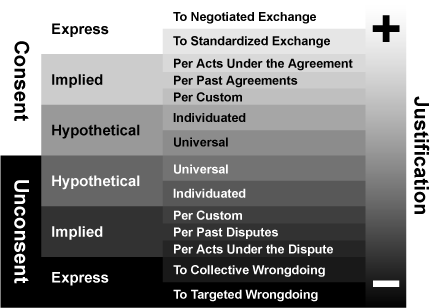
As the abstract suggests, The Scale of Consent offers but one part of a larger writing project, tentatively titled, Consent by Degrees, A Theory, Explained and Applied. I spun off this working paper because Consent by Degrees was growing unwieldy and I wanted to get some feedback before committing it to print. I hope you will see fit to comment on it.
I'm excited about this foray into consent theory, which I think friends of liberty will find useful. I should note, however, that the theory of graduated consent I'm working up does not clearly support originalism, a theory of constitutional interpretation dear to many libertarians. We can debate that later, though. The Scale of Consent aims simply to build the theory's engine, leaving the chassis, the wheels, and the wild road trip for later.