Sunday, May 02, 2004

Carrots, Sticks, and the Begging of Questions

Frequent commentator trumpit sent me the link to this LA Times article by Peter Garrison. In it, Garrison complains about how the idiom “to beg the question” has almost entirely lost its original meaning. These days, it is mostly used to mean, “to induce one to ask the question,” as in this typical example:

The Twins are up by five runs, and Lohse can't be sent back out there, and the real bullpen pitchers need a rest, but this still makes me nervous. Which begs the question, if you can't use him now, when can you use him? Which begs the question why is he in the major leagues? Which begs the question, what are Terry Ryan and Ron Gardenhire thinking? link
Originally, “begging the question” meant to use a circular argument, i.e., one whose conclusion is sneakily used as one of the premises. Garrison is not alone in this complaint. These guys here make the same one, and I’ve been bugged by the newer usage for years.

I even complained about it to my wife one day, but she was not sympathetic. She had several points. First of all, “beg the question” in its original sense is certainly not a semantically transparent phrase. What connection is there between “begging a question” and “using an argument’s conclusion as one of its premises”? Actually, there is one, which Evan Morris (aka The Word Detective) states concisely:
It means to bypass or avoid an essential question, but to proceed as if it had already been answered.
Even so, the semantic connection between begging and bypassing or avoiding is pretty tenuous, and not likely to be made by someone encountering this idiom for the first time.

Second: When someone does hear the phrase for the first time, they have every reason to treat it like any other English pharse, and create a meaning for it using their already-existing definitions for “beg” and “question.” Since you can’t actually beg a question to do something, guessing that it means to practically beg someone to ask some question is a pretty reasonable course to take.

Third: Of course, if they looked up the idiom, they’d find out what it meant, but as Geoff Pullum argues, you can’t look up everything . And why would you look up this phrase, anyway, once you’ve figured out a plausible meaning? It’s like when you get a bad grade because of some misunderstanding, and the teacher says, “If you didn’t understand, you should have asked me”—dammit, until I got this grade, I thought I understood perfectly! If someone says to you, “I eat bologna sandwiches,” are you going to look up the phrase “eat bologna sandwiches” to see if it’s an idiom?

Ultimately, I had to concede to my wife that criticizing someone for thinking that “beg the question” means “induce one to ask the question” is little more than saying, “Ha, ha! I’ve read books on logic and you haven’t! I know the code and you don’t!”

Returning to the LA Times article... Garrison generalizes his complaint, arguing that when terms for specific concepts lose their meaning, people are less likely to be aware of the concepts they denote. I have three things to say here. One: maybe, and maybe not. This claim is a version of what linguists call the Sapir-Whorf hypothesis, whose validity has not been established. Second: in this particular case, Garrison needn’t worry, because there’s another, more semantically transparent term for the concept--circular argumentation. And third, what would he say in a case where the goals of preserving a term’s original meaning and having a term for a useful concept were in opposition? This brings me to the other topic of this post: carrots and sticks.

My dad has brought to my attention the rampant misinterpretation of “carrot and stick.” Whenever you read the phrase in editorials or hear people use it, they mean “simultaneous use of rewards (carrot) and punishment (stick) to produce a desired behavior.” A typical example:
Jeb Bush is proposing a carrot-and-stick approach: reward school districts that have already tried and punish those that fail. link
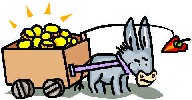
But the phrase seems to have come from the image of dangling a carrot in front of a mule or donkey in order to get it to move forward in an attempt to get the carrot which is always just out of reach, as illustrated here and here. So the carrot is a reward (albeit an unreachable one), but the stick is just what keeps the reward out of reach, not an instrument of punishment. Evan Morris comments on the commonly used meaning for this phrase, too, here. In fact, it seems that even knowing of the origin of the phrase is not enough to keep the newer meaning at bay, as this cartoon shows.

Now I can definitely see Dad’s point, but what I haven’t had the heart to tell him is this: I think the phrase “carrot and stick” is more useful where it is now. First of all, you can’t look up everything. If you’re not familiar with the image of a carrot and stick used with a donkey, what are you going to think when you hear about motivating someone with a carrot and stick? I’d probably think of Teddy Roosevelt’s “Speak softly and carry a big stick,” and get the rest from context. Second, if everyone were to start using “carrot and stick” strictly in its original sense tomorrow, we would lose a convenient, short way of referring to a simultaneous use of rewards and punishment to produce a desired behavior, a concept that is useful in describing many situations. What would we gain in return? A convenient, short way to refer to one particular means of motivating a donkey or mule.

Which meaning would you rather have for "carrot and stick"?

Read More...

Friday, April 30, 2004

The Air Down There

According to an old (possibly apocryphal) story, economist Armen Alchian was once asked the following question: “If you could wave a magic wand and eliminate all of the pollution in South Central Los Angeles, would you do it?” To which Alchian allegedly replied, “No. It would be cruel to raise those people’s rent like that.”

I usually tell that story to my students just to jolt them into thinking differently (that is, like an economist) about environmental issues. But lately I’ve been wondering if Alchian’s comment might be even more insightful than I’d realized. Environmentalists sometimes get lathered up about “environmental injustice” or “discriminatory pollution,” meaning the location of pollution in regions populated by poor people and minorities. If we take Alchian’s point seriously, the problem is bogus, because the market rental rate for apartments and homes in the affected regions falls enough to reflect the undesirable effects of pollution. And taking the argument one step further, what this means is that the real victims of pollution are not the residents, but the land owners who get paid lower rents. The value of their land diminishes.

But taking the argument yet another step, perhaps even the current land owners are not the real victims, so long as the pollution has been around for a while. Consider the analogy to a property tax. A property tax reduces the value of the property, because the owner is obligated to pay a stream of future taxes. When the tax is imposed for the first time, the current owner suffers a reduction in the price for which he can sell his land, because it’s now burdened with a tax liability that is capitalized into the land’s value. But if he sells the land to a new owner, the new owner does not take a hit, because the tax liability is reflected in the lower price. Yes, it appears that the new owner suffers, because he must pay property taxes – but if not for the taxes, he would have paid a higher price for the property. The price differential should be approximately equal to the present discounted value of the stream of tax payments. In effect, a property tax is borne entirely by the land owner at the time of the tax’s imposition.

The analogy to pollution should be clear. If there is an increase in pollution in a particular region, and that increase is expected to be permanent, then the cost of the pollution gets capitalized into the land value. The owner at the time of the pollution increase suffers, but subsequent owners do not, because they are compensated by the lower sale price. Subsequent owners suffer new damage only from further increases in the pollution burden. Renters suffer damages during the period in which their rent remains at the level set prior to the increase in pollution.

I haven’t worked all the way through the logic, but my suspicion is that these considerations don’t really change the economist’s prescriptions for how to deal with externality problems. For most economists, the key question is whether the gains from the polluting activity are greater than the reduction in value of all the affected land. A policy allowing current owners or renters to sue for damages might (and I emphasize might, because I’m leaving out a lot of relevant caveats) internalize the externality and produce the efficient outcome. But interestingly, my analysis above indicates that this policy would be awarding damages to people who may not have suffered any actual (uncompensated) harm. On the other hand, if such a policy already existed at the time of the purchase of the land, that, too, would be capitalized into the sale price – this time by raising it. The higher price would be compensated by the expectation of a future legal settlement.

If there’s a policy implication of my speculation here, I think it probably comes down to this: In the absence of substantial administrative costs, the following two policies would have equivalent effects: (a) a policy that allows current owners and renters to sue for damages from new or existing pollution, and (b) a policy that allows only owners at the time of a permanent increase in pollution to sue for damages from pollution. But in the presence of administrative costs, (a) would involve lawsuits every year, whereas (b) would allow all lawsuits to be handled just once, thereby minimizing administrative costs. On the other hand, (a) and (b) might only be equivalent when the benefits and costs from the polluting activity are relatively constant over time, thus assuring that pollution that’s efficient when it first appears continues to be efficient thereafter. If the costs and benefit change substantially over time, (a) might handle better the need for change in pollution levels.

Read More...

Wednesday, April 28, 2004

Rape Inflation

In today’s Dear Abby, a 17-year-old complains about her boyfriend who wants to have sex all the time. At the end of her letter, she says:

The other day, I told Johnny I didn’t want to do it, but it happened anyway. I didn’t resist, so it wasn’t like he raped me or anything, but it wasn’t right.
And here is part of Abby’s reply:
And I have more bad news – when a person says "no" to sex and it “happens anyway,” that is the definition of rape.

I urge you to pick up the phone and call the R.A.I.N.N (Rape, Abuse, Incest National Network)… They can help you to clearly understand what happened and find counseling.
A charitable interpretation of Abby’s remarks is that she thinks the writer may have been raped, and RAINN can help her figure out if she was raped or not. But as I read it, Abby’s saying a rape did occur and RAINN can help her to realize that’s what happened.

The writer never indicates that she said “no.” All she says is that she didn’t want to have sex. I’m sorry, but merely having sex when you don’t feel like it does not count as rape. Lots of people consent to have sex just to make their partners happy. If you don’t want to go to work in the morning, but it happens anyway, that’s not slavery, that’s life. Sometimes people do things they’d rather not do. Now, maybe she did say “no” but neglected to mention that fact to Abby. Possible, but the only evidence provided points exactly in the other direction: the writer expressly states that she was not raped. Instead of assuming the writer doesn’t know what rape is, why not take her at her word? Rape is a serious accusation, and it shouldn’t be thrown around in situations where all indications point to the guy just being a jerk.

Abby would be on stronger ground if she had focused on statutory rape. The writer called herself “Too Much Sex in Victorville,” and the only Victorville I know of is in California, where the age of consent is 18. The writer doesn’t state Johnny’s age, and in any case, I’m not sure whether California has an exception for minors having sex with other minors. (If there is no such exception, and two minors have sex with each other, are both guilty of statutorily raping each other?) With statutory rape, consent is not germane, so the whole “no” issue is beside the point.

For more on what’s rape and what’s not, read Dan Savage’s trenchant comments here and here.

Read More...

Tuesday, April 27, 2004

A Troop of One

This was the headline on the front page of the Columbus Dispatch today:

(1) Blast kills 2 U.S. troops.
The names of the two soldiers were not given, but before I get to my linguistic point, let me say that the families of these soldiers have my sympathy, and all the troops have my respect and appreciation for the dangerous job they’re doing on my behalf.

Now about this headline talking about "2 troops": The definition I had for troop for many years was essentially this one (definition 1a in Webster’s New Collegiate Dictionary): “a group of soldiers.” In high school, I gradually began to realize that this definition was not sufficient to let me understand some of the sentences I was hearing or reading with the word troops in them. During my U.S. history class in 9th grade, I remember hearing about how President Kennedy had sent some number of troops (I don’t remember the number, but say 50,000) into Vietnam, and wondering, “OK, so how many people does that translate to? 50,000 times…what? Fifty soldiers per troop? A hundred?” The textbook never made it clear. By about halfway through college, it was finally dawning on me that troops could also (and usually did) mean just "members of the armed forces," so 50,00 troops simply meant 50,00 soldiers.

I see that this definition has been around long enough that it is definition 1c in the same dictionary quoted above: “armed forces: SOLDIERS – usu. used in pl.” The last four words are the kicker: “usually used in plural.” Ye-e-e-es, exactly. So on the one hand:
(2) 1 troop = X soldiers, where X > 1 (and probably a 2- or 3-digit number)
But on the other hand:
(3) 50,000 troops = 50,000 soldiers
Dividing both sides of equation (3) by 50,000, we get:
(4) 1 troop = 1 soldier
Now clearly that can’t be right, can it? Somewhere between 1 and 50,000, there must be some number N such that (N-1) troops means some number of soldiers greater than N-1, and N troops means N soldiers. For years, I’ve been wondering what this number is, lowering it now and again as I come across other examples of lower and lower numbers of troops. And now that I’ve learned that 2 troops can mean 2 people, it looks like I’ve reached the limit.

Or have I? I’ve just done a Google search for the phrase “one troop,” and found at least one attestation in which 1 troop = 1 soldier:
One troop was shot in the leg this morning in a TERRORISM CRACKDOWN inspired by DONALD RUMSFIELD and FOX NEWS CHANNEL.
link
I found plenty of examples in which troop referred to a group of people (most of them boy scouts or girl scouts), and some in which the ambiguity really causes confusion. In this one, I just couldn’t tell whether the one troop and the other troop consisted of one person each, or more than one person each, or a combination:
During further attacks on the strongpoint, one troop engaged enemy from the south, enabling the other troop to cross the wire and the minefield. After a brief encounter one troop entered the strongpoint and the enemy surrendered.
link
And looking further in my Google search, I see my point has been anticipated by columnist Debra Lo Guercio, in a funny piece with a much more prescriptive slant, here.

Read More...

There's No Such Thing as a Free Ice Cream Cone

Julian alerts us to Ben & Jerry’s annual Free Cone Day. “TISATAAFICC” (There Is Such a Thing as a Free Ice Cream Cone), he says, playing off Robert Heinlein’s TANSTAAFL (There Ain’t No Such Thing as a Free Lunch) slogan.

Julian’s only joking, as I'm sure he realizes the slogan doesn’t mean that you personally always pay, but that someone always pays. B&J’s pays the cost of production and (most likely) classifies it as a marketing expense. But in this case, it turns out that the free cone recipients have to pay, too. I went to a B&J’s store a few years ago on Free Cone Day, and I ended up waiting about an hour in line to get my free cone. That could be a pretty steep price for someone with a high opportunity cost of their time. In retrospect, it would have made more sense to just a buy a pint at the convenience store.

Incidentally, Heinlein actually didn’t invent the TANSTAAFL slogan (though he may have been responsible for the acronym version). Here’s the origin of the saying.

Read More...

Monday, April 26, 2004

Oral Expression in French

Geoff Pullum of Language Log recently posted about one brief shining moment when he successfully deployed his limited Finnish well enough to sound like a fluent speaker. It reminded me of my favorite story of about speaking French. It was back in the summer of 1990 … [harp music, picture getting wavy]

Glen and I were traveling in Europe, staying in youth hostels (well, trying to stay in them, but that’s another story) and other cheap lodgings. It was a Friday night, and we had just ridden the ferry from Dover, England to Calais, France. We got there at about midnight. Glen and I had heard about a campground in the area, and luckily, this was one of the lodgings we were actually able to find (after an hour of hiking through an industrial district). The check-in office was closed, though, and besides, it turned out we didn’t have enough money to stay there—as usual, we’d gotten caught on a Friday night without having converted enough of our travelers’ checks to the local currency, and all the money exchanges were closed. So we decided we’d just have to sneak in through one of the broken bars in the fence that surrounded the grounds, and sleep in shifts in the open air.

The campground was a flat, sandy park, partially surrounded by low terraces. The one we chose was slightly elevated on a low hill from the rest of the camp, and from it we could keep an eye out for possible security guards. On the other side of the fence, the hill descended about fifteen feet to a broad parking lot outside the camp, and beyond was the shore, so we had a good view of what was going on all around us. Glen agreed to be the first to sleep, so he spread out one of the sleeping bags next to a bench that sat in the middle of the terrace, shoving our bags underneath the bench. After two hours, I woke Glen and we switched places. I pulled off my shoes and climbed into the sleeping bag as he began his watch.

"Neal, wake up!" was the next thing I heard. "Someone's coming!"

Oh, great, I thought, it's a guard come to throw us out. Well, I'd better get ready to speak some polite French with him. Glen pointed to the approaching figure, and it wasn't a guard at all. It was a man, coming not from the campground, but from the parking lot below. I recognized him: It was a dark-complexioned, black-haired guy I'd seen on the beach during my watch. We kept watching as he walked up the sidewalk toward the terrace, as it became apparent that he was indeed aiming for us. Finally he appeared at the edge of the terrace.

"Bon soir," I said. Glen stood at a distance, watching.

"Bon soir," the man said. He walked over to the bench and sat down. He seemed to be in his mid-twenties, was clean shaven and had dark eyes. I was still sitting up in the sleeping bag, making sure I could still feel my wallet in my pocket.

He introduced himself--his name was Luigi--and made friendly conversation. Not wanting to antagonize him, I conversed. I learned that he had an Italian name because he was, in fact, Italian, but was working here at some nightclub. He learned that Glen and I were brothers, and seemed a little surprised. The conversation continued with lots of small talk, and I began to wonder if Luigi had a point. I kept making sure I knew where my wallet was and where the travelers' checks were stashed; Glen kept walking around on the patio, keeping an eye on us. As Luigi sat and talked, I began to get annoyed. How long did he plan to stay? Why was he just sitting here and talking with a total stranger? What did he want? Didn't he know we were trying to sleep?

I was still sitting in the sleeping bag when Luigi pointed to my shoes and said something about them. I didn't catch exactly what he said, but I did hear chaussures, so I said yes, those were my shoes. Then he shook his head, pointed again, and I realized he was indicating the foil-like lining of the sleeping bag that was visible next to the shoes. Ah, I must have heard him say not chaussures, but chaud. He was asking if the sleeping bag was hot, probably impressed with the hi-tech lining. So I said sure, it was pretty warm, thinking that this was about the most pointless turn the conversation had yet taken. Luigi reached down from the bench to the sleeping bag and felt the lining with the back of his hand. What, I was thinking, he just has to see for himself how incredibly warm the lining is? Then he reached into the sleeping bag and I finally got the picture.

I jumped out of the sleeping bag, sat on the opposite end of the bench from Luigi, and started putting on my shoes. There was an awkward silence. Then Luigi turned to me and asked,

"Tu veux faire sucir?"

Did I want to what? I couldn't believe I’d heard him right, though I guess at this point I should have. They hadn’t taught the verb sucir in my high school French class, or even in my advanced oral expression French class at college. But I remembered it from a pornographic French novel I’d read, so after asking him to repeat the question, I answered, "Euh…non, merci."

There was another awkward pause. Luigi asked, "Moi a` toi?" (Me to you?)

No, that didn't really change things. "Non."

He was silent for a little longer, and then he nodded in Glen's direction. "Et lui?"

I didn't ask Glen before I told Luigi, "Lui non plus" (Him neither).

Luigi nodded, said, "Tant pis" (too bad), got up, and wandered back the way he'd come.

"What was that all about?" Glen wanted to know. I waited until Luigi was back on the parking lot below, making his way to the beach, before I told him.

Read More...

Meaningless Driving Statistics

This MSN article reports the results of a focus group composed of 30 bad drivers (people with a large number of accidents or traffic violations in the three years). The article contains a plethora of totally meaningless statistics, including:

• 77% of bad drivers say they frequently or occasionally talk on cell phones while driving.
• 60% of bad drivers say they frequently or occasionally eat while driving.
• 60% of bad drivers say they get frustrated when SUVs or other large vehicles obstruct their vision.
• Nearly all bad drivers say they change their driving behavior when they know police are nearby.
• 93% of bad drivers say they listen to the radio while driving.

“If your answers agree with the answers from the focus group,” says the article, “it's likely you tend to be a more aggressive driver than average.” But the figures given show nothing of the sort, because they provide no point of comparison. The article provides no comparable figures for a control group of typical drivers, and therefore we have no idea whether the bad drivers’ percentages are relatively large or not. I wouldn’t be surprised, for instance, to find out that 93% of all drivers listen to the radio, or that 60% of all drivers occasionally eat while driving. And just about everyone I know drives extra carefully when police are around.

The point is not, of course, that none of these behaviors are dangerous. The point is that we need more information in order to distinguish the truly dangerous activities from the innocuous ones.

Read More...

Friday, April 23, 2004

Black Is White, Up Is Down...

As a result of the California state budget crunch, the CSU system has taken some hits. Its funding from the state has been reduced, and fees – i.e., tuition – have had to increase. Naturally, the California Faculty Association (the teachers’ union of which I am an unwilling member) vigorously opposes all this. I received a CFA flyer in my mailbox this week announcing a rally against cuts, and one of its slogans has been sticking in my craw for a couple of days now: “Fee Increases ARE Tax Increases.”

That’s not just an overstatement; it’s about as nearly opposite the truth as I can imagine.

First, taxes are involuntary payments, usually made irrespective of whether the payer receives any service in return. Fees, or at least these fees, are voluntary payments (you only pay them if you attend a CSU institution), and the payer is the direct recipient of the educational benefits.

Second, CSU students receive a massive subsidy. According to some estimates, it costs around $10,000 per academic year to enroll one student full time, whereas the fee is about $2400. So the typical student is receiving a subsidy of about 75% off the cost of education. A fee increase is not a tax; it’s a reduction in the size of the subsidy. When people say student fees have increased by 58% in recent years, they’re referring to the fact that fees used to be around $1500 and have risen to about $2400. To put that in perspective, the size of the subsidy has dropped from about 85% to about 75%. (Incidentally, these figures don’t take into account inflation. In real dollars, the percentage increase would be a good bit less than 58%.)

Third, for the actual taxpayers, a fee increase is an alternative to a tax increase. If the fees did not increase, the only way CSU could keep its funding would be through increased taxes or borrowing (and of course, borrowing just means more taxes from future taxpayers). Raising fees is thus a way to avoid taxing the rest of public – you know, all those people who are not getting a heavily subsidized education – even more.

Read More...

Thursday, April 22, 2004

Are You Looking for Purpose in Your Life?

Then look no further. (Link courtesy of Bryan Westhoff.)

Read More...

Brain Politics

Tyler Cowen links to a fascinating article about how the brain reacts to stimuli of a political or ideological nature.

At the start of the session, when they look at photographs of Mr. Bush, Mr. Kerry and Ralph Nader, subjects from both parties tend to show emotional reactions to all the candidates, indicated in the ventromedial prefrontal cortex, an area of the brain associated with reflexive reactions.

But then, after the Bush campaign commercial is shown, the subjects respond in a partisan fashion when the photographs are shown again. They still respond emotionally to the candidate of their party, but when they see the other party's candidate, there is more activity in the rational part of the brain, the dorsolateral prefrontal cortex. "It seems as if they're really identifying with their own candidate, whereas when they see the opponent, they're using their rational apparatus to argue against him," Professor Iacoboni said. [emphasis added]
The research is really too preliminary to reach any political conclusions; as Tyler notes, there were only 11 data points. But what the heck – what’s a blog for, if not for throwing out half-baked ideas? Here’s what I’m thinking: this is yet another argument for divided government. When one party controls both the executive and legislative branches, the members of the party respond emotionally to most policy proposals, and nobody with power is thinking rationally about them. With divided government, there will always be someone in power who will think rationally about the other side’s proposals. This is, perhaps, why the Republicans only discover their limited government principles when there’s a Democrat in the White House.

Read More...

Wednesday, April 21, 2004

If You Turn the Gun on Yourself, Do You Have to Shoot It?

I always pause and think for a second when I read or hear news stories that contain sentences like this one:

(1) He killed 3 people before turning the gun on himself.
Those of you who know me personally may be guessing that my reaction is, “I didn’t know you could turn a gun on! I’ve never seen a power switch on one!” Well, you’re right, but that’s not what I want to talk about here. Another reaction, of course, is disgust with the actions of the killer, but I don’t want to talk about that either.

I’m wondering why it is that the expression to "turn a gun"on oneself always seems to imply that the gun wielder also (a) fires it, (b) hits the target, and (c) dies from the wound. I mean, Dad always told me, “Don’t point a gun at anyone unless you are planning to kill him,” but not everyone follows this rule. Plenty of people turn guns on people (including themselves) and only threaten to fire them. And even those who do follow the rule, and turn guns only on those they mean to kill, can still miss. Furthermore, even those who hit their target (self or otherwise) might fail to deliver a fatal shot. I know that turned the gun on himself doesn’t have to mean “killed himself,” because I can say this:
(2) He turned the gun on himself, but decided not to fire it.
I did a Google search for “turn the gun on”, “turned the gun on”, and “turning the gun on” and examined the first 3 pages of hits for each search. Of the 60 relevant examples I found, 53 of them (96%) were followed by a reflexive pronoun (himself, herself, etc. –mostly himself), and of these 53, only two were not clear cases where turning the gun on oneself meant killing onself. Even in these two cases, though, the gunmen actually did kill themselves, but that detail was made explicit later on, instead of being implied by the turn the gun phrase. Here they are:
(3) Gonzalez then turned the gun on himself and committed suicide.
(4) Deculit turned the gun on himself. "He blew his brains out," Witkowski said.
Of the 7 examples that mention turning the gun on someone other than oneself, 5 of them mean killing that someone. And as with the turn-gun-on-self cases, in the remaining two turn-gun-on-someone-else examples, the gunmen actually did kill their victims, but that fact was made explicit elsewhere.

So overall, then, if you read that someone turned a gun on someone , chances are near 100% that the second someone got killed. OK, so far so good. Now how about this:
(5) He killed 3 people before pointing the gun at himself.
Now the killer probably survived, maybe surrendering, or being disarmed by the police. Why doesn’t this sentence imply the same thing as (1)? Well, I have one pretty good reason. Larry Horn talks about this kind of situation as the Division of Pragmatic Labor. As it applies here, we’re used to hearing turn the gun on as a synonym for “shoot and kill,” so if someone deliberately chooses a less common phrasing, the audience infers that the speaker is trying to convey some message that would not be conveyed simply by using the more common phrasing. In this case, the message is, “He only pointed the gun; he didn’t actually fire it.” But now my question is: Why did turn the gun on become the more common way of expressing the idea of “shoot and kill”, while point the gun at did not? I’m assuming it was just a random thing, but if someone knows different, I’d be interested in hearing about it.

Oh, by the way: I also learned during the Google search that you can turn a gun on, as demonstrated in examples like this:
(6) If you simply turn the gun on, it will automatically default to standard semiautomatic mode.

Read More...

Tuesday, April 20, 2004

The Trade-Offs of Style

Many of the rules of grammar and style you learned from your high school English teachers are pointless and stupid – a point the folks at Language Log have made repeatedly. I don’t oppose all linguistic prescriptivism (see here and here), but there’s no doubt that many of the most common prescriptions are ridiculous. One example came to mind while I was grading some student essays. I noticed a significant fraction of students insisted on using constructions such as, “A regression analysis was performed…,” and “Conclusions were reached that….” Why not just say, “I performed a regression,” and “I conclude that…”? Because somewhere along the line, they had English teachers who told them never, ever to use the first person. As these examples show, following that admonition strictly means violating another English teachers’ admonition, which says never to use the passive voice.

Both prescriptions serve a legitimate goal. Students permitted to use the first person will often litter their writing with I’s, even where they’re totally unnecessary – e.g., “I found an article by John Smith arguing that…” instead of “John Smith argues that….” And students permitted to use the passive voice will use it to avoid stating who did what – e.g., “Mistakes were made” instead of “Administration officials made mistakes.” But it’s nearly impossible to follow both rules strictly without writing some incredibly awkward sentences, which is why both should be regarded as rules of thumb. I don’t recall a single one of my English teachers admitting that. I suspect the problem stems from one or more of the following: (1) Some English teachers don’t understand the rationales for the rules. (2) English teachers who understand the rationales don’t think students will understand them. (3) English teachers need hard-and-fast grading rules, lest their marks appear arbitrary. I’m sympathetic to this last reason, which is one reason I’m much happier grading math than writing. But if you’re going to teach English properly, there’s no avoiding the burden of subjectivity in grading.

Addendum: The previous sentence was supposed to be the last, but then I noticed it began with the word “but.” That’s another English-class no-no that I break without remorse. If I didn’t break it, a lot more of my sentences would be run-ons. See? Another trade-off. D’oh! That was a sentence fragment…

Read More...

Sunday, April 18, 2004

Game Show Theory

A couple of years ago I was a contestant on Win Ben Stein’s Money. I didn’t win, but my name got put into the producer’s file of “good game-show contestant types.” As a result, I’ve been asked a couple of times since then to audition for other game shows. A couple of weeks ago, I auditioned for an upcoming show called “On the Cover,” and in so doing I figured out some interesting things about the selection process.

In both shows’ auditions, the first step was a 30-question quiz. After the quiz had been graded, the producer read the names of those who had “passed,” and everyone else was dismissed. But neither time did he reveal the number of correct answers that were required in order to pass. During the “Ben Stein” audition, I wondered why not. During the “On the Cover” audition, the reason became clear. Before giving the quiz, the producer explained to the participants why cheating on the quiz (say, by looking at your neighbor’s answer sheet) would be a bad idea. Show contestants, he said, are matched against others with similar scores on the quiz. If you cheat, you might increase your chance of being on the show, but only by increasing your chance of getting trounced in front of a national audience.

And that’s when I realized the reason for the secret pass-bar: If people knew the pass-bar, they might deliberately miss questions in order to get matched against inferior contestants. If the pass-bar were 20, for instance, and if you knew the answers to at least 25 questions, you might deliberately miss four (or if you're really confident, five) of them. The secret pass-bar makes it more difficult to game the system that way. (Though not impossible; if you knew the answers to all 30, you might guess you could safely give wrong answers to two or three, because it’s hard to imagine the pass-bar being set that high.)

But why should the producers care whether people end up mismatched? The obvious reason is that a close game is more interesting to watch. The more important reason, I suspect, is monetary. In a game where a single person has a chance to win a large prize while the runner-ups get a pittance (as was the case on “Ben Stein” and will be the case on “On the Cover”), matching the best contestants against each other reduces the expected cost of prizes, because only one of them can go home with the big prize. Matching the worst contestants against each other increases the number of episodes in which the big prize is not awarded.

As an added bonus, “departing contestants” like me can console ourselves with the knowledge that we were pitted against known equals (or near-equals), not just a random draw from the contestant pool.

Read More...

Friday, April 16, 2004

A Child's Garden of Versus

A week or two ago, Doug was contemplating the fun he and his cousin could have if they could get together and do a two-player round of one of his videogames. He said:

(1) My Ice could verse his Flame.

Oho! I thought. A previously undetected misanalysis has now revealed itself!

The first I encountered the word versus was when the movie Kramer vs. Kramer came out. I was in 5th grade, so I could read the word on the movie posters at the same time as I was hearing it, and I never had a chance to interpret it as a 3rd person present tense of some unfamiliar verb. But Doug, who has spent a good it of time playing games on his Nintendo 64, has heard versus on numerous occasions. In particular, there's one game called "Super Smash Brothers," with all the characters from all the Nintendo games engaged in a big tournament, and at the beginning of every round, the announcer will say, "Mario versus Pikachu!" or "Link versus Jiggly Puff!" or something similar. If I were 5 years old, and heard the formula "X versus Y," without seeing it written down (or knowing how to read it if I did see it), what would the more rational conclusion be? That there is some weird preposition that I've never heard anywhere else, used only when two people are fighting, or that there is a verb, verse, which means "to fight"? Option B, of course! And all this time, when Doug and I talked about Mario vs. Pikachu, little did I know that I was saying Mario versus Pikachu while he was saying Mario verses Pikachu. Only now has our difference in understanding come to light. Who knows how many other differences like these are camouflaged, just waiting for the right kind of sentence or context to reveal them?

As with Doug's use of like (in a previous post), I expect we'll see more and more use of verse as a verb meaning "to fight" as Doug's generation grows up.

UPDATE: My prediction seems to be on the mark, at least judging by something Glen passed along to me:

[One of Glen's colleagues] says that the use of verse as a verb meaning "compete against" seems pretty common among young people. She said her son, who is about 9, uses it sometimes, and she's heard his friends use it, too. She said her son now understands the correct (or original) meaning of versus ... but that doesn't stop him from employing the new usage from time
to time.

Read More...

Thursday, April 15, 2004

Electoral Collage

Showtime is going ahead with its plan to air "The American Candidate," a reality show in which contestants vie to become the people's candidate to run for president. The contestants will be eliminated from the show Survivor-style. But I can already see one little bitty problem. According to the website, you can enter the contest if you're 18 years or older. Oops. According to the Constitution of the United States, you must be at least 35 to be eligible for the presidency. A quick search reveals at least 25 people under 35 who have entered the contest. (To be fair, those who are 34 might be 35 by inauguration day, and the website only implies that we're talking about the 2004 election.)

Read More...

Wednesday, April 14, 2004

Pleasure and Pain

A nutrition brochure I was reading said something along these lines:

(1) To lower your risk of cancer, enjoy 3 to 5 servings of fruit per day.

So if you've just been choking down your daily servings of fruit for the health benefit, this message seems to say, too bad for you. It's not enough just to eat the fruit--you have to enjoy it, too.

Of course, the writers were really just using enjoy as a synonym for eat, and trying to put a positive spin on it. Actually, it's used as a more general synonym for have, as seen in this example:

(2) American citizens enjoy the right to vote.

The main thought is just that American citizens HAVE the right to vote, and by the way, they in general like having it. This synonym usage goes away, though, when we start talking about individual people, as in:

(3) Glen enjoys the right to vote.

This sentence means that by golly, Glen takes pleasure in exercising that right!

I've identified one other verb that's used this way, and it's a near-opposite of enjoy: suffer from. It is used as a synonym for have in the following sentence, with a negative spin on the having:

(4) 50 million Americans suffer from hemorrhoids.

This could just mean that 50 million Americans HAVE hemorrhoids. (In fact, I'm almost certain it does mean this.) But on the other hand, the speaker could conceivably mean that of all the 60 million or so Americans who have hemorrhoids, 50 million of them actually suffer from them. The other 10 million who are indifferent or who kinda like them are not being discussed. Interestingly, this synonym usage doesn't go away when we're talking about specific individuals. In (5), suffers from still just seems to mean has:

(5) Kim suffers from hemorrhoids.

I wonder what happens if I replace suffer from in (4) with enjoy ?

(6) 50 million Americans enjoy hemorrhoids.

Now we get the ordinary, non-specialized meaning of enjoy. The sentence tells us nothing at all about how many Americans actually HAVE hemorrhoids; it just says that 50 million Americans derive pleasure from hemorrhoids, perhaps by having them, or maybe by looking at them, collecting them, or something else.

These examples remind me of a similar situation with adjectives, in sentences like this:

(7) Our friendly employees will be happy to assist you.

But our surly ones won't, I always want to add. If they were describing the employees with a relative clause, they could avoid the ambiguity by using commas, like this:

(8) Our employees, who are friendly, will be happy to assist you.

In (8), the friendliness is definitely a "by the way" piece of information, packaged in a non-essential relative clause. If the smart-ass interpretation of (7) were to be phrased with a relative clause, it would be one not set off by commas, like this:

(9) Our employees who are friendly will be happy to assist you.

But enjoy and suffer from are different from these adjectives or relative clauses. "By the way" information carried by adjectives or non-essential relative clauses can be deleted from the sentence without changing the main idea; thus, you could say Our employees will be happy to assist you, leaving out the friendly, but still getting the main message across. But in enjoy and suffer, it's built right into the verb itself, and can't be removed without wrecking the sentence.

UPDATE: Mark Liberman has written more about enjoy and suffer from at Language Log, and his posting reminded Q. Pheevr of a quotation from Pippi Longstocking that shows Astrid Lindgren suffered from the same kind of literal-minded streak that I do.

Read More...

Tuesday, April 13, 2004

Popperian Astrology

Here is a great story about science versus mythology (link courtesy of Crooked Timber). Here’s the short version (or as close I can come to short): Astrologer Thomas Seers claimed that astrology could be taught in a science class. Skeptic Robert Grumbine asked him to provide an example of a testable hypothesis from astrology that could be used in class. Seers responded with this: “On 10/20/99 from 2 AM to 8 AM EDT, mix a bowl of jello and you will find it won't gel. My basic students have this as a homework assignment to learn of a void-of-course Moon period.” (Note: I have corrected the spelling errors.) Apparently the void-of-course Moon period is a time of bad luck when stuff tends to go wrong; the failure of jello to gel would be an example. Here was Grumbine’s response:

Experimental Results:
10/20/99 at 2:30 AM EDT my wife mixed a batch of consumer-grade jello according to directions. She split the jello to two containers, one about 1.5 cups, and one about 4, and put into the fridge. When I checked at 6:50 AM EDT, both had firmly jelled.

10/21/99 at 3:45 AM EDT my wife again mixed a batch of consumer-grade jello and split in to two containers as before. At 8:00 AM EDT, both had jelled, though the large was somewhat un-firm.

Conclusion:
We followed Mr. Seers procedure both at a time he predicted that the jello would fail to jell, and on a 'control' day. On neither day was there any difficulty apparent in the jelling procedure. His prediction is falsified.
Read the whole thing, because there’s much scientific mirth to follow – such as Grumbine’s hypotheses about why Seers’s jello failed to gel. But it was Seers’s attempt to squirm out that I found especially amusing: He “disqualified Grumbine's results because he mixed his box of jell-o in two bowls. That was ‘breaking up the substance’.”

Now that’s funny, because it seems to me Seers had a killer excuse readily available. The void-of-Moon period is supposed to bring about bad luck and stuff going wrong. When you want your jello to gel, it shouldn’t -- but if you’re doing an experiment to show that it won’t gel, it should gel after all! Thus, Seers could claim that Grumbine’s experiment was an example of things going wrong, confirming the astrological hypothesis. This is a problem that could be solved with better institutional design. Two researchers, one astrologer and one skeptic, should run a double-blind experiment, wherein the actual jello makers don’t know what the experiment is supposed to show.

Read More...

Monday, April 12, 2004

Drug War Follies

Eugene points to a news story about a man who complained to the police about a woman who stole his drugs:

[Police officer Philip] Anelli said the man told him that he and a woman were riding around when he decided to pay for two rocks of crack cocaine. The man planned to smoke one of the rocks and give the other to the woman in exchange for sexual favors. The plan was apparently moving along fine, until the woman smoked both rocks and then ran off without giving up any favors.
After being told that he, too, would likely be in legal trouble if his story were confirmed, the man “weighed his options, then told authorities that he felt like he and the woman could work out the problem on their own, without help from police.”

A pretty funny story, but there’s a serious point here. The illegality of drugs and prostitution means the justice system cannot help people enforce their contracts and property rights in those markets. And that’s exactly why black markets are typically characterized by violence. If a drug dealer wants people who transact with him to know he won’t put up with being defrauded, he has to hire thugs to punish those who defraud him. If a prostitute wants to be sure she’ll get paid for her services, she hires a pimp to pressure the recalcitrant johns. People with a comparative advantage in violence naturally get pulled into these professions, with predictably brutal results. In the story above, I have to wonder… what methods might this fellow have had in mind to “work out the problem on their own”?

Read More...

Friday, April 09, 2004

Can You Task Someone with Hardening a Target?

I heard some of Condoleezza Rice’s testimony before the Sept. 11th commission on the radio yesterday, and heard her and her questioners use task again and again as a verb, as in:

(1) to task someone to do some job
(2) to task someone with doing some job
(3) to task some job to someone

I hadn’t realized task could be used this way, but I did two Google searches, and found about 9300 hits for the string “tasked * with”, and about 8400 hits for the string “tasked * to”. During a cursory check of some of the results pages for “tasked * to”, all the relevant hits I saw were examples following the pattern in (2), none following (3). I don’t know if that’s because that usage really is less common than the one in (2), or just because examples following this pattern tend to have more than one word between tasked and to. I did find 9 examples, though, when I searched for the string “tasked the job of”, most in passive sentences such as I was tasked the job of ….

The other usage that struck me was from Rice’s opening statement, which contained the phrase harden terrorist targets. I’ve been familiar with the phrase hard target since I saw the 1993 Jean-Claude van Damme movie of that name. I’m also well familiar with the verb harden, meaning “to make or become stiff or inflexible” (in a literal or figurative sense). But this is the first time I’ve heard harden used to mean “to make or become more difficult”. I didn’t try a Google search on harden, since I hesitate to think of the kind of websites I’ll get directed to with that keyword. But I did try it on the Linguists Search Engine, requiring that it be used as a transitive verb, and didn’t find any other instances of hardening targets, games, or tests. Have any of you readers heard harden used in this way?

Read More...

From the Mouths of Babes?

Betsy Newmark had her high school government students take part in a budget-balancing simulation, with interesting results:

The liberal kids happily cut away at military spending, NASA, and foreign aid. They were then dismayed to find that they hadn't cut very much of the deficit. The conservative kids whittled away at social welfare and increased the tax cuts. They too were unable to make substantial headway on the deficit. However, the cut that both the liberals and conservatives agreed on was whacking away at Social Security and Medicare. Cries of "throw Granny off welfare" and "buy your own drugs" were heard. They were ruthless. Some of them reduced Social Security down to zero, cackling cheerfully all the while.
In general, I’m suspicious of “from the mouths of babes” interpretations, because kids hold all kinds of magical and bogus beliefs. Ask a group of children what they’d do if they were president, and they’ll say “give everyone free healthcare,” “give everyone a good job,” “give everyone a pony,” etc. And liberals will latch onto these statements and observe how young children really know what’s important, unlike all those crotchety old folks who would turn a cold shoulder on their fellow man. So I’m hesitant to say “from the mouths of babes” when the result is one I find more pleasing.

Still, I think a useful lesson comes out of Newmark’s classroom experiment, and it’s the same one her students learned: you can’t have everything you want, so something has to get cut. The simulation in question is far better than the open-ended questions usually posed to kindergarteners because it incorporates some real-world constraints, and the difference in outcomes is apparent. Of course, the subjects were high schoolers who may already have been tainted by their elders’ jaded and cynical worldviews…

Read More...

Thursday, April 08, 2004

Do Men Have a Right to Abortion, Too?

WARNING: This post is way too long.

In a letter to Reason magazine (not yet available online), Brian Sorgatz writes:

It is hypocritical of the government to guarantee a woman’s right to an abortion while forcing a man to pay child support against his will. As Karen DeCrow, former president of the National Organization for Women, said, “If women have the right to choose if they become parents, men have that right, too.”

Paternity suits should be abolished. Every argument in favor of them is a mirror image of an argument against legalized abortion. Compare: “If men don’t want to support their offspring, they should use condoms” with “If women can use the pill, why do they need a right to an abortion?” And when so-called deadbeat dads are labeled irresponsible, it mirrors the anti-abortionists’ stereotype of women who want abortions as irresponsible sluts.
This is an argument to be taken seriously, although I’m not sure whether I agree with it in the final analysis. There is a real incongruity in the way women’s and men’s obligations to potential future offspring are treated. Think of it this way: Both a man and a woman have the opportunity to avoid parenthood by abstaining from sex. But once they’ve had sex, the woman has at least one additional opportunity to avoid parenthood – by having an abortion. The man does not have this option. If he has sex that results in conception, and if the woman chooses to give birth and raise the child, the man is on the hook for child support – whether or not he wanted to have a child at the time of sex, whether or not he favored an abortion, whether or not he wanted to give it up for adoption. I’ll consider a few responses to this line of argument that I don’t think quite work, and then a response I think is more viable.

1. The obvious response is to say, “He accepted the risk of having to pay child support when he had sex.” But as Sorgatz indicates, this is an argument that abortion rights advocates always reject when it comes to a woman; “She accepted the risk of having a child when she had sex” is not considered a valid argument against abortion. To put it another way, the woman does not accept that risk when she has sex; the incongruity demands justification.

2. Another response is to note the potentially dire consequences of Sorgatz’s policy. Wouldn’t we end up with lots of children being raised by single moms, without any financial support from their fathers? Sounds plausible. Then again, the incentives would change. Knowing they could not obligate their sexual partners to pay child support, more women might (a) refuse to have sex in the first place without some contractual promise of support, (b) use more reliable birth control methods, or (c) have more abortions. On the other hand, they might just rely more on public welfare – indeed, reducing the welfare burden is one major reason the government works so hard to identify deadbeat dads and make them pay. However, the fact that the government has established exploitable welfare programs is not the fault of men who choose to have sex. Blaming such men for creating a burden on the welfare system is a little like blaming the Gap for letting your teenage daughter run up a monstrous credit card bill. If you wanted to avoid that burden, you should have refused your daughter the credit card (or given her a card with a low credit limit). And besides, the welfare burden argument could be directed just as plausibly against women who choose not to have abortions, thereby creating more future welfare cases.

3. Another response notes that repudiation of child support is not thoroughly analogous to abortion. An abortion prevents a child from ever coming into existence, whereas the repudiation of child support denies funds to a child who already exists. If we think of child support as an obligation owed to the child, not to the child’s mother, then the situations differ because an abortion avoids creating the source of the obligation. There are two difficulties with this argument. First, our legal system does not really treat the obligation to support one’s child as unavoidable. If both parents choose not to keep the child, it can be put up for adoption, and neither biological parent will be obligated to provide for it – even if no one but an orphanage will take it. Yet when the biological mother decides to keep the child, the father is financially obligated. Thus, the woman has the ability, post-sex, to create a financial obligation on the man.

Second, from an economic perspective, there is something perverse about imposing liability on the party who has the least opportunity to prevent that liability from existing in the first place. The man has one opportunity to prevent the occurrence of a child (abstaining from sex), while the woman has two (abstaining from sex, having an abortion). In general, if you want to give people the right incentives, you want to place liability on those who have the greatest capacity to reduce its incidence. In the current system, where liability is distributed over both parties, the woman who chooses to carry a child to term (and keep it rather than give it up for adoption) imposes an external cost on whoever else has to pay for it – either the father or the state. The result is an inefficiently small number of abortions.

4. In my opinion, all the above responses are inadequate, although #3 comes close to satisfying me. But here is a response that I do find (relatively) convincing. Think of sexual activity as creating an implicit contract about how to deal with any consequences that arise. Ideally, the contracts would be explicit: people about to engage in coitus would specify in detail the terms of their intercourse, including the obligations of each party vis-à-vis any pregnancy that might arise from the act. If the parties could not reach mutually agreeable terms, they would not have sex. Of course, this would never happen, because people about to have sex are not inclined to stop long enough to have a summit meeting, write up an agreement, call a contract lawyer, etc. In other words, transaction costs are too high, so people rely on a vague, implicit contract instead.

In this kind of situation, the legal system must decide the default terms of the contract. I suggest it should do so by asking the following hypothetical: If people did take the time to agree on a contract, what would the terms be? We can never know the answer for sure, in part because different couples would likely reach different contracts, while an implicit contract by its nature is one-size-fits-all. But the economic theory of bargaining gives some hints as to the likely outcome. Contracts rarely impose perfectly symmetrical duties; instead, what the parties give and receive depends on their threat points, meaning what their positions would be if no bargain were reached. In this case, there is good reason to believe that women have a stronger threat point. If popular stereotypes are correct, then men (in general) desire sex more, and thus they are willing to make more concessions to get it. Even if they are dealing with a particular woman who wants sex a great deal, she likely has many outside options (other willing partners), and that competitive pressure will tend to reduce the man’s relative bargaining power. Finally, the potential downside of the bargain, pregnancy, is a more serious burden for women, and therefore more favorable terms will be necessary to induce women’s cooperation.

In short, if women and men wrote contracts before sex, it seems pretty likely that women would successfully demand a variety of concessions from men. The resulting contract might look a lot like the status quo. You might characterize the contract as having three signature lines – one for the man, and two for the woman. Each person “signs” the contract once by having sex. But no child, and no parental obligations, result unless the woman “signs” a second time by not having an abortion. Essentially, the contract includes an option to be exercised at a later time by one party. This is quite common in the world of business – stock options, for example, give the owner a right (but not obligation) to buy stock at a specified price at a later date – so I see no reason to rule them out of sex contracts.

One implication of the contractual approach I’ve outlined here is that the status quo ought to be modified to allow explicit “opting out” of the one-size-fits-all contract. The courts of law cannot avoid imagining implicit contracts from time to time, because people often engage in transactions without written terms, and even written contracts often leave some contingencies unaddressed. But an implicit contract only establishes a default, which can usually be overridden by an explicit contract with different terms. In the present case, anyone would be able to demand a modified and explicit contract as a pre-condition of sex. If the other party refused, then either (a) they wouldn’t have sex, or (b) they’d have sex anyway, in which case the default rules would apply. In practice, I suspect this system would look very much like the status quo, because most people would continue to have sex without lengthy negotiations. But the right to opt out would free the system from the troubling appearance of coercion and discriminatory treatment observed by Sorgatz.

P.S. To anti-abortion folks: Yes, I'm pro-abortion. But I've had that argument too many times for it to be interesting anymore, so this post takes the correctness of the pro-abortion position as given.

Read More...

Tuesday, April 06, 2004

Ideological Wheeling and Dealing

Tyler Cowen and Brad DeLong just had an interesting exchange (Tyler 1, Brad 1, Tyler 2, Brad 2, Tyler 3) on the subject of libertarianism versus liberalism (or, if you prefer, classical liberalism versus modern liberalism). In the end, Tyler offered Brad a deal: he would agree to vote against a presidential candidate specified by Brad, if Brad would post (without irony) the following message on his blog: “The classical liberal recipe of increased immigration is superior to strengthening the welfare state. I just don't think it will or can happen, so I will advocate the next best thing.” Brad took the deal, with some caveats.

I must say that Tyler got the better of this deal, because one vote ain’t worth much. I know a lot of people who’d sell theirs for a ham sandwich. But then again, Brad didn’t have to give up much – he just had to state the truth.

Lynne Kiesling offered the following commentary, which is what really got me thinking:

After reading all of this, though, I continue to think that an argument for classical liberalism over modern liberalism cannot be premised on pragmatic/utilitarian/consequentialist terms alone. I think the question to pose to Brad is this: do you want a social environment based on the primacy of the individual and on negatively-defined rights? I think that core philosophical question will always separate the mutton from the lamb, so to speak.
Here’s why Lynne’s mistaken: Tyler’s proffered deal was accepted, whereas I strongly suspect Lynne’s would have been rejected. Why? Because deontological arguments are simply not as persuasive as consequentialist arguments to the vast majority of people. Given a choice between (a) closing a deal that would result in a somewhat more libertarian society and (b) losing a deal that would have resulted in a very libertarian society if it had just been accepted, I’ll take the first one.

More later.

Read More...

Monday, April 05, 2004

Ooh, Baby, You Know What I'm Like

Doug, age 5, routinely says things like this (and has been doing so for a couple of years):

(1) He was like, “Why’d you do that?” That’s what he was like, Daddy.
Now I am a fluent user of the like of reported speech or thought, and will often utter sentences like the first one in (1). But the second one? No way. At least, not with this meaning of like. For me, what he was like can only mean “what he was similar to” or “what kind of person he was.”

The second sentence in (1) is an example of one kind of “extraction,” in which the object of a verb or preposition or some other word does not appear in its ordinary position, instead appearing nearer the front of the sentence. Here are some examples of extraction which just about every speaker of English could say, with the ordinary position for the extracted object indicated by the __, and extracted object itself underlined:
(2) Topicalization: (I didn’t see Glen, but) Neal, I saw __.
Question: Who did you see __?
Cleft: It was Neal that I saw __.
Free relative: That’s what I saw __.
What Doug has done in (1) is to use the like of reported speech/thought in a free relative construction, precisely along the lines of That’s what I saw in (2). Just as what corresponds to the missing direct object of saw here, what corresponds to the missing reported speech/thought following like in (1). I’ve also heard him make questions with like (What was he like? meaning, “What was his reaction?”), though I haven’t heard him do topicalizations or clefts with it.

Why is extraction with like so natural for Doug and so wrong for me? My gut feeling is that the like of reported speech or thought is just different from ordinary verbs, prepositions, or even adjectives. It's even different from the truly adjectival like, which I can extract from just fine:
(3) A cold fish is what he was like __.
But why is it different? How? The only thing I can put my finger on is that this usage of like is a late addition to my grammar, and feels different stylistically from everything else. Doug, however, hears this like without any of the baggage that I have, and quite rationally subjects it to the same extraction rule that other verbs and verb-like words or phrases are subject to. In this way, the slippery slope event I referred to in my last posting has come to pass. I predict we will all hear a lot more of sentences like (1) as members of Doug's cohort grow up.

The difference between Doug's like and mine becomes even more radically apparent when he says stuff like this:
(4) I was like, just about to win, is what I was like.
Good heavens! Now he's gone too far! Not only does he subject to extraction the like of reported speech/thought , he dares to do it with the conversational-hedge like! Muffy Siegel did a well-publicized study on this use of like, but even she says she hasn't heard anything like (4).

Read More...

The Slippery Slope of Language

Glen had some interesting comments on my last posting, where I discussed sentences following the pattern of Others were attempted to be killed. He said:

In order to make that conclusion [that this construction is grammatical], wouldn't you need to know the frequency with which [it] appears relative to other constructions that express the same idea? Or, perhaps, the frequency with which native listeners and readers have an adverse reaction to it? After all, if the phrasing struck *you* as wrong, and it struck *me* as wrong, I'll bet it strikes *lots* of people as wrong.
What I found with my corpus search was that it was common and regular enough that I could not in good conscience simply dismiss it as a speech error. I found enough examples that, if this were a foreign language I were documenting, the prima facie conclusion would be that for at least some speakers, the way to turn a sentence like Someone attempted to kill others into a passive is to make both attempted and kill passive. Now I agree that there are probably a lot of speakers who, like Glen and me, find the sentence ungrammatical, or at least odd. From a linguist’s point of view, all this means is that people like Glen and me are speaking a different language from the people who have this construction. True, the languages are mostly alike, enough so that the speakers of each can easily understand each other, but they are different languages nonetheless. A more common way of referring to languages that are mutually intelligible (as these two are) is to call them dialects of the same language.

Glen continues:
It might even strike some of the speakers as wrong. I can easily imagine saying trying to construct a passive voice sentence, realizing halfway through that it couldn't *quite* be done, and finishing incorrectly rather than starting over.
Good point, if we’re talking only about spoken English. However, the other examples I found were in written English, which has had more time to be corrected by its authors. But even granting this point, suppose that all my examples are instances of people completing a sentence even though they know it’s not grammatical, just because they can’t think of a better way of doing it in the time they have. Now imagine you’re a kid learning the language. When you hear these sentences, as far as you know they ARE grammatical, and you infer a rule to generate them, without the mental baggage that the earlier speakers may have attached to them. And now in your grammar (and in the grammar of many of your peers who were exposed to similar input), these sentences are a completely legitimate part of your language.

As Mario Rizzo and Glen might put it, a “slippery slope event” has occurred: Letting the ungrammatical sentence pass has allowed speakers acquiring the language to accept it as grammatical. And now that their grammar will generate this kind of stuff, who knows what other surprises will be generated by whatever rule they’ve inferred? And from the rules that the next generation of speakers infer from what they hear this generation saying? This kind of slippery slope is a common way for language to change; John McWhorter, in The Power of Babel, describes it quite entertainingly. The process is so common that I even have an example from my own life, but since this posting is long enough, I’ll save it for my next one.

Read More...

IHS Seminars: Apply NOW

Other bloggers have recently sung the praises of the Institute for Humane Studies (IHS), but I wanted to join the chorus. If you’re a college or graduate student, and you have an interest in the ideas of liberty, I highly encourage you to apply for one of IHS's free summer seminars. You won’t regret it. The official application deadline was March 31, but they’ve decided to continue accepting applications through April 9 (this Friday). It’s an online application, and it doesn’t take long to fill out. The application deadline for the Social Change Workshop, which grad students should consider especially seriously, is April 15. Hey, did I mention that the seminars are free?

I first attended one of these seminars in 1992, and I’ve been a faculty member for the last three summers (and will be again this summer). As a student, I found the seminar both inspiring and mind-blowing; and even now, over 10 years later and with a lot more education under my belt, I still find it among the most intellectually stimulating events of my year.

Read More...

Sex in Prime Time

I’ve never been fascinated by prime numbers, in part because I never really saw their practical application for anything except mundane mathematical chores (like finding a lowest common denominator). But this could make me a convert: Why do cicadas come out to breed only once every 17 years?

Read More...

Sunday, April 04, 2004

Passive Aggression

Here in central Ohio, they’ve been busy getting the (most recent) highway sniper suspect Charles McCoy indicted, and the latest yesterday was about how Franklin County Prosecutor Ron O’Brien will be seeking the death penalty. Here’s what he said, as recorded on the front page of the Columbus Dispatch:

(1) We are alleging that there was a course of conduct over a period of time in which one person was killed and others were attempted to be killed.
This is one of those situations where I say, “I know what you’re trying to say, but I just don’t think it can be said that way.” O’Brien is using the passive voice in order to keep the focus on the events, and the first time he does it, there’s no problem. If you have an idea that would be expressed like (2) in the active voice, phrasing it in the passive, as in (3), is pretty straightforward:
(2) Someone killed one person.

(3) One person was killed.
But what happens when you try to do it with something like (4), where the verb you intuitively want to make passive (kill) is not the main verb?
(4) Someone attempted to kill others.
The main verb here is attempted, and kill is just part of the infinitival complement of attempted. If you put the direct object of kill in front and put the main verb attempt into the passive, you get this:
(5) *Others were attempted to kill.
Eww. That sentence just ain’t right, as I’ve indicated with the *. So what do you do instead? If you’re Ron O’Brien, you go ahead and put kill into the passive, too:
(6) Others were attempted to be killed.
As it turns out, it’s not just the Franklin County Prosecutor who does it. I searched via Linguist’s Search Engine and Google for other instances of some form of be+attempted+to+be+[passive participle], and found plenty of them. Below are a few (the first from LSE, others from Google). Examples also exist with try, but my impression was that more of them came from sites in countries where English is not the primary language.
  • He stated the provision in the State law was attempted to be corrected this year
  • Corrections are attempted to be diagnosed and fixed within a 24 hour period.
  • “During play'” is from the time play is attempted to be started or is started, until “play ends.''
  • Additional major funding for this project will be attempted to be obtained from New York State Insurance Committee
  • Never before has such an eclectic palette of music been attempted to be put into one mix
  • I've never seen so many fakes and forgeries in one area being attempted to be sold as genuine articles.
In fact, I found only one clear example of someone constructing a passive along the lines of (5):
(7) How to handle errors when an IMG/Image is attempted to load?
So, it looks like I was wrong: I know what Ron O'Brien was trying to say with were attempted to be killed, and you can say it that way. It is not an error in sentence planning, but an apparently fairly regular way of putting attempt and try (in their infinitive-taking incarnation) into the passive. What is even more interesting to me, though, is that even though all the example sentences I found make sense, they don’t seem to do so in a semantically compositional way. That is, it’s not enough to know what each word means in were attempted to be killed, and build up the meaning of the phrase piece by piece (as can be done with was killed)—you have to impute some of the meaning to the phrase as a whole. (Either that or just give up and say that the last piece of the meaning doesn’t come from the grammar; we just kinda get it from the context.) In short, these examples support the idea behind a theory known as construction grammar (i.e. that some of the meaning of phrases comes not from any particular word in them, but from the construction of the phrase itself), and pose a problem for strongly lexicalist theories, which assume all meaning of a phrase is wired into individual words and built up into larger and larger parts of the phrase.

UPDATE: Mark Liberman tells me that the kind of passive I attempted in (5) has a name: long passive. Though it is ungrammatical in English, it is fairly common in German. Results of a corpus search for it done by Susi Wurmbrand can be found here. As for whether other languages without long passive use the same double-passive alternative seen here, I don't know.

Read More...

Rules We Follow Without Knowing It

Neal’s post below, in which he described his 5-year-old son’s use of a rule of English pronunciation that he almost certainly could not describe, reminded me of the following passage from Hayek:

The first of these attributes which most rules of conduct originally possessed is that they are observed in action without being known to the acting person in articulated (‘verbalized’ or explicit) form. They will manifest themselves in regularity of action which can be explicitly described, but this regularity of action is not the result of the acting persons being capable of thus stating them.
Hayek was speaking of rules in a different context – the rules of ethical and just conduct. But he recognized the generality of his point:
We cannot consider here the difficult question of how men can learn from each other such, often highly abstract, rules of conduct by example and imitation … This is a problem most familiar to us in the learning of language by children who are able to produce correctly most complicated expressions they have never heard before; but it occurs also in such fields as manners, morals, and law, and in most skills where we are guided by rules which we know how to follow but are unable to state.
(Both passages appear on p. 19 of Hayek’s Law Legislation and Liberty, Vol. I: Rules and Order.)

Read More...

Friday, April 02, 2004

Gotcha, Cucaracha

Last night I was singing “La cucaracha” while I gave Doug a bath. I was pronouncing the r with the Spanish pronunciation. This sound is often referred to as the tap or flap, and we also have it in English: It is the same sound you make for the t in atom, or the d in Adam. (It sounds a lot like a [d], but it’s not—try making a careful [d] sound in Adam, and it will sound strange.) I’ll transcribe this sound as D, so I was singing:

(1) La cucaDacha, la cucaDacha!

Doug starts singing it, too, but like this, with a regular, plain old English [r]:

(2) La cucaracha, la cucaracha!

Now why did he do that? If he were reading the word, I would expect him to pronounce the r as [r], but he’s never seen this word written! All he had to go on was what he heard me say, and he heard me saying [D]. Doug has been making the flap sound for years in dozens of ordinary English words (including his brother’s name, Adam), so why should he suddenly turn this one into an [r]? I mean, suppose Doug had heard me say some unfamiliar English word that contained a flap, such as adage. Would he repeat it as arage? I can’t imagine he would.
There is, however, one difference between the flap in English words such as Adam the and the flap in Spanish words such as cucaracha. In English, the flap always occurs after a stressed syllable and before an unstressed one. For example, if we write out Adam with D indicating the flap and boldface underline indicating the stressed syllable, we get ADam. But doing the same thing with cucaracha, we get cucaDacha. So maybe Doug was picking up on the difference in stress. I tried an experiment with just the cara part of the word:

Me: Say caDa
Doug: caDa
Me: Say caDa
Doug: cara

How about that? He’s got the English flap rule well-internalized … as of course he should, being a native speaker of English. I’ll have to try a few other nonsense syllables with flaps in them to see what he does.

Read More...

Thursday, April 01, 2004

The Ramblin' Linguist Returns

My brother Neal has consented to join Agoraphilia for another guest blogging stint, this one of indeterminate length. Welcome back!

Read More...

The Significance of Insignificance

Remarking on some recent poll results, Eugene says, "Repeat after me: I will not think that statistically insignificant changes in poll results are statistically significant -- even if I really, really like them."

In general, I agree with Eugene’s point (which he has made many times): people ascribe way too much import to small differences in polling results, without paying attention to the margin of error.

However, Eugene’s position may foster the false impression that all differences in poll results that fall within the margin of error are equally insignificant. Suppose that two candidates are separated by just 2 percentage points in the polls (say, 49% to 47%), and the margin of error is 3 percentage points for each figure. And suppose that two different candidates in another election -- or the same two candidates in a later poll -- are separated by 6 percentage points (say, 51% to 45%), again with a margin of error of 3 percentage points for each figure. While both differences are “insignificant” in the sense that the difference is within the combined margins of error, the latter result is clearly more significant than the former.

Indeed, the latter result would most likely have been deemed statistically significant had a very slightly lower level of confidence been applied. The margin of error is constructed using a conventional but essentially arbitrary confidence level. The typical convention is 95% confidence, but other levels of confidence could also be used; 90% and 99% are relatively common. These are the confidence levels employed by scientists, who don’t want to affirm a hypothesis unless they are very confident of it, and who are willing to remain agnostic in a wide range of cases. Lower levels of confidence might well be acceptable in other contexts, such as business, where some decisions have to be made without great confidence (e.g., should I plan to expand next year if I am 75% confident that consumer demand will pick up?). It’s not obvious what the appropriate level of confidence is for political prognostication, but I’ll put it this way: in the example given above, I would be willing to bet a larger amount of money on the second race than the first.

The broader point is that statistical significance is not an all-or-nothing proposition. Despite the way statistical significance is often taught, there is not a sharp discontinuity between significance and insignificance. Significance lies on a gradient.

Read More...

Wednesday, March 31, 2004

Dietary Efficiency

Economists’ and engineers’ minds are very similar, as indicated by (among other things) the fact that many economist jokes are recycled engineer jokes, and vice versa. It’s no coincidence that my dad is an engineer. But one major difference between them is their notions of efficiency. Engineers’ notion of efficiency is typically driven by the physical or technological relationship between inputs and outputs. Economists’ notion of efficiency, on the other hand, is typically driven by subjective human valuations.

Here’s a nice illustration: What does it mean for the human body to be “a more efficient machine”? That’s a phrase you’ll sometimes hear about the alleged effect of dieting and exercise on the human body. To an engineer, a more efficient human body would presumably be one the generates the greatest amount of energy (or work) from a given amount of caloric intake. But I suspect that is not the kind of efficiency people want out of their bodies, at least in the modern age of cheap food. What most people (or Americans, at any rate) really want is a body that burns up lots of calories without really doing much with them. We want to maximize the amount of tasty food we can ingest without having to exert energy to lose the calories. And we don’t even want the calories to be stored; that just means fat. Nope, what we want is to waste calories.

The point is that our bodies could be inefficient from an engineering perspective and yet economically efficient. Economic efficiency is measured in terms of preference satisfaction, and a body that “wastes” lots of calories actually makes many of us happier.

ADDENDUM: Just to be clear, I realize that engineering efficiency could be “tweaked” to make it isomorphic to economic efficiency. It’s just a matter of redefining what the relevant inputs and outputs are. My point is about how notions of efficiency are typically deployed by the two professions. Specifically, economists usually place much greater emphasis on the subjective aspect of the problem.

Read More...

Monday, March 29, 2004

The Two Things about the Two Things

A couple of months ago, I blogged about the two things. Lots of people commented, and others replied on their own blogs. As a result, I now know…

The Two Things about the Two Things:
1. People love to play the Two Things game, but they rarely agree about what the Two Things are.
2. That goes double for anyone who works with computers.
Why do people love to play the Two Things game? I suspect it's because two is a welcome change from the hackneyed three. Three leaves room for fluff, while two forces you to give a lean and mean summary of what's really important, without the padding. And why do computer people love the game even more? On that one, I'm unsure. It could be the result of the inherent bias of having asked the question on the web. Or it could be the whole binary thing, though no one went so far as to call their list the "10" Things.

I have now created a Two Things webpage, which includes all the Two Things entries I’ve found thus far. Please feel free to send me more, and I’ll update the list periodically.

(In the earlier blog post, I promised to post only the best entries. But there was lots of disagreement, especially for anything computer-related, so I decided to just post them all and let the reader decide.)

Read More...

Friday, March 26, 2004

Everything Must Be Required or Banned

The Georgia House of Representatives recently voted to ban female genital mutilation. Most likely, they were rightly appalled at the cultural/religious practice of clitoridectomy. (Were they motivated in part by anti-Arab sentiment? I wouldn’t be surprised, and that’s sad. But on this matter, multiculturalism loses in my book. Cutting up your daughters’ genitals doesn’t become okay because it’s a cultural or religious practice. And yes, I think that about male circumcision, too.) But in a typical example of legislative overreaching, the Georgia state legislators went ahead and banned genital piercing as well, even when voluntarily chosen by adults. Once again, government can’t seem to make that crucial distinction between “inherently wrong” and “wrong because it’s not by choice.”

Read More...

Thursday, March 25, 2004

What's Not at Stake in the Pledge Debate

This report by Dahlia Lithwickon the oral arguments before the Supreme Court in the Pledge of Allegiance case (a.k.a. Elk Grove United School District v. Newdow) highlights a delicious irony of the “under God” side’s position. The folks who have been beating their breasts about the powerful importance of the phrase “under God” can only win the constitutional debate by admitting the phrase is not really important at all! The key argument in support of their position is that the phrase “under God” is nothing more than ceremonial deism with no real (or at least, no serious) religious connotations. If the phrase carries any more significance than that, the Justices will have little choice but to strike it down as unconstitutional. Having “under God” in the Pledge is either (a) meaningless and constitutional or (b) meaningful and unconstitutional.

Only if the Supreme Court vacates the Circuit Court’s decision on grounds of standing will the “under God” crowd be able to have their cake and eat it, too. No wonder they’ve spent so much time focusing on the standing issue: they don’t want the Court to decide the First Amendment issue at all, because no outcome of that decision would be a favorable one. They just want this case to go away.

Read More...

Wednesday, March 24, 2004

Lucifer, the Lord's Servant

Radley links to this pants-wettingly funny Onion article, from the Onion’s first post-9/11 issue. The article got me thinking about the economics of the afterlife again. The usual Bible story is that God and the Devil are enemies. But if you think about the functional quality of hell, it would seem that Lucifer still serves the Lord. God wants people to behave virtuously and eschew sin. The pleasures of heaven provide a carrot, the torments of hell provide a stick, and together they constitute a comprehensive incentive program. If Lucifer had really wanted to spite God, wouldn’t he have made hell a glorious paradise? Inquiring minds want to know.

This question seems so obvious that I figure somebody must have asked it before, but I don’t know who.

Read More...

Tuesday, March 23, 2004

Slip-Sliding Away

You can now access my co-authored (with Mario Rizzo) article on slippery slopes, mentioned in a previous post, without Lexis-Nexis access. I don’t normally advertise my own articles on this page, though perhaps I should – all the other academic bloggers do. But I decided to mention this one since slippery slopes discussions have been popular in the blogosphere lately. And before anyone asks: Yes, I’ve read Eugene Volokh’s article on slippery slopes, which is excellent and cited in Mario’s and my article.

Read More...

Sunday, March 21, 2004

Orgasmetrics

Steve Landsburg talks about the economics of orgasm (thanks to Alex for the pointer). I can’t improve on Landsburg’s explanation, so just read the article. However, I do think he makes one incorrect inference:

According to the 2000 Orgasm Survey (did you know there was a 2000 Orgasm Survey?), 72 percent of women have faked at least once in their current or most recent relationship, and 55 percent of men say they can tell when their partner's faking.

Apparently someone's deluded, though it's not clear whether it's the woman who overestimates her acting ability or the man who overestimates his perceptiveness.
Hold on, there. It wouldn’t be surprising to find that someone’s deluded, but the statistics cited don’t prove it. 55% is not the percentage of men who think they’ve caught a faker, or the percentage of recent sexual relationships that men perceive to have involved faking. 55% is the percentage of men who say they can detect faking when it occurs, and that is perfectly consistent with 72% of women faking.

For example, assume (for argument’s sake) that the pairing of women and men for sexual relationships is independent of women’s tendency to fake and men’s perceived ability to detect faking. Then the two figures together imply that approximately 40% (55% x 72%) of recent sexual relationship paired faking women with men who thought they could detect faking. If the men are correct about their detection abilities, we should expect 40% of men to have detected faking by their last partner. If a survey indicated that 40% of men had in fact detected faking in their most recent relationship, there would be no particular reason to think any men were deluded about their perceptiveness. If the survey indicated otherwise – if fewer than 40% of men said they had detected faking partners – then we would have evidence that some men are, in fact, deluded about their perceptiveness. (Either way, some men are being fooled, in the sense that some women are faking undetected. But being deluded, as Landsburg uses the term, means overestimating your perceptiveness or acting ability – i.e., thinking you couldn’t have been fooled when you were.)

However, even the evidence of fewer than 40% of men having detected faking by their last partner, if such evidence existed, would be tainted by the independence assumption. It might be that faking women are most likely to stay with men who are easily fooled, because nobody wants to get caught. A countervailing effect would result from women choosing to dump men whose inability to satisfy them leads them to fake more often. The balance of the effects could go either way, but suppose the first effect is larger. Then we would expect to get faking women paired mostly with oblivious men, and non-faking women paired with perceptive men. In this scenario, while there would certainly be many men getting fooled, few people would actually be deluded in Landsburg’s sense of the word, because most or all of the men being fooled would also recognize their lack of perceptiveness.

Read More...