Showing posts with label privacy. Show all posts

Wednesday, June 02, 2010

A T-Shirt to Save Miranda

Professor Crim Pro I ain't, but it seems to me that anybody who has used a computer can pretty easily grasp the holding of Berghuis v. Thompkins, 560 U.S. __, No. 08-1470 (June 1, 2010) [PDF]. In that opinion, handed down just yesterday, the U.S. Supreme Court toggled the default on the Miranda warning. A five-justice majority held that silence will not suffice for citizens who want to invoke Miranda's protections against self-incrimination; we now must ask for our Constitutional rights. Think of it like a computer program that annoyingly assumes you want unsolicited advice from a chirpy paper clip--except this paper clip throws you in cuffs and tazes you if you talk back.

The Berghuis decision inspires me to offer a new piece of legal armor—this time in the form of a t-shirt:
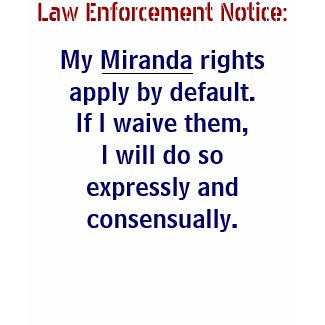
Miranda Rights Notice shirt

Click on the picture to buy a shirt, or borrow the text (I've uncopyrighted it) to make your own version from scratch. Combine that notice of your Miranda rights with the bumper sticker and magnetic sign I offered earlier, in defense of your rights to record and report what public officials do to you, and you might just dodge some serious legal hurt. Or—who knows?—you might inspire some interesting and important litigation.

I leave detailed analysis of how Berghuis jibes with Miranda and other precedents to other, more knowledgeable commentators (see supra, "ain't Prof. Crim Pro" disclaimer). I dare say, though, that Justice Sotomayor's dissent hit a nice note:
Today’s decision turns Miranda upside down. Criminal suspects must now unambiguously invoke their right to remain silent—which, counterintuitively, requires them to speak. At the same time, suspects will be legally presumed to have waived their rights even if they have given no clear expression of their intent to do so. Those results, in my view, find no basis in Miranda or our subsequent cases and are inconsistent with the fair-trial principles on which those precedents are grounded.
Slip. op. at 23 (Sotomayor, J. dissenting).

I guess that you could say the Berghuis majority took a cue from the (so-called) libertarian paternalists and engaged in some legal nudging. In this case, however, the Court nudged our defaults away from individual liberty and toward prosecutorial power. Call it statist paternalism.

Thanks, Supremes, for giving us worse than nothing. Ah, well. As I read Berghuis, even the justices in the majority would not deny us the opportunity to answer their new default with a firm "No!" Thus might we recover our Constitutional rights with a t-shirt.

[Crossposted at Agoraphilia and The Technology Liberation Front.]

Read More...

Sunday, May 30, 2010

Police May be Monitored for Quality Control Purposes

While police and prosecutors have encouraged the growth of a surveillance state, they don't seem so enthusiastic about the growth of a surveillance citizenry. Maryland and other states have recently seen privacy laws invoked to squelch the unauthorized recording of public officers performing public duties in public areas. Until courts put an end to those bogus claims, we should make sure that police officers know that we may monitor traffic stops to protect our rights; I below offer a bumper sticker and magnetic door sign that ought to help on that front.

Radley Balko recently reported on the latest attempt to use privacy laws to punish citizens for recording police misconduct. In this case, Anthony Graber was arrested for posting on YouTube a video he'd captured on an un-uniformed Maryland state trooper, driving an unmarked car, pulling over and rushing at Graber with a drawn handgun. Soon after Graber posted the video, he was charged for violating the Maryland Wiretapping and Electronic Surveillance Act, Md. Code Ann., Cts. & Jud. Proc. § 10-401 et seq. (2010), which basically outlaws secretly recording a private conversation.

Maryland's police must be feeling a bit testy, these days, about getting recorded on-the-job by uppity citizens. Earlier this spring, an inconvenient video of the beating of Jack McKenna put the lie to the claims of Maryland police that McKenna had provoked the incident by attacking the officers and their horses. State and federal officials have since launched "excessive force" inquiries.

Did that video violate the privacy of the three officers, clad in riot gear and swinging batons, who surrounded and beat the unarmed McKenna? No. Neither did the video that Graber shot of the Maryland trooper strutting towards him with a drawn handgun. Courts have already explained that wrongs under the Maryland Wiretapping and Electronic Surveillance Act require a showing that someone's reasonable expectation of privacy has suffered violation (see Fearnow v. C & P Tel. Co., 104 Md. App. 1, 655 A.2d 1 (1995), rev'd on other grounds, 342 Md. 363, 676 A.2d 65 (1996)), and no officer can have a reasonable expectation of privacy while on a public street, performing public duties.

The Maryland ACLU has stepped forward to help defend Graber, and with any luck will soon educate local prosecutors about the proper scope of the Maryland Wiretapping and Electronic Surveillance Act. In the meantime, and in other jurisdictions where police threaten to deploy privacy laws against whistle-blowers, we citizens would do well to remind public servants that we can and will record their on-the-job performance. I've worked up a couple of notices to help.

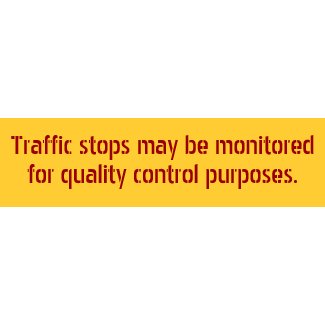
This bumper sticker should help to put police on notice that you may record them during traffic stops, thus negating any claim to a reasonable expectation of privacy:

Traffic stops may be monitored . . . bumpersticker
Make sure that you place it where video taken from the officer's vehicle will record it! That proof might end up helping your case if, like Graber, you want to publicize police abuse.

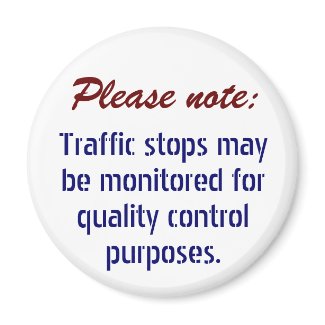
To make doubly sure that you give adequate notice to an officer who subjects you to a traffic stop, you might also want to carry this handy magnetic sign:
Traffic stops maybe monitored . . . magnet
Once you have been pulled over, just roll down your window and slap the sign outside your door, where a police officer cannot fail to see it.

Click on either image to buy a copy for yourself or a friend. All proceeds will go to aid the defense of Anthony Graber. Perhaps his case would have turned out differently if he had had that bumper sticker on his helmet, or that magnetic sign on his gas tank. (I thank Prof. Orin Kerr for inspiring the wording of these notices, though he of course bears no blame for my legal hijinks.)

In the long run, as Prof. Glenn Reynolds has observed, we in the surveillance citizenry have an edge over those trying to create a surveillance state. We have more eyes, more cameras, and a more sympathetic message. There remain, however, several legal wrinkles to iron out before we can safely say we've turned the tables. I'll try to say more about those, and offer an all-purpose notice designed to cover a wide variety of citizen surveillance practices, in a subsequent post.

[Crossposted at Agoraphilia and The Technology Liberation Front.]

Read More...