Back in 2005 and 2007, I wrote a couple of posts about the "Annual Rite of Overdue Dumping." I claimed this event occurs early in the year, especially right after Valentine's Day. I hypothesized that the dump-fest results from a backlog of potential break-ups that were postponed to get through the holiday season. I also suggested some game-theoretic reasons to think the cycle becomes exaggerated (higher highs and lower lows) when people take others' behavior into account in their mating choices.
In the comments, some readers wondered whether the Annual Rite of Overdue Dumping was a real phenomenon. I was forced to admit that I had no hard data, only my perceptions about when people break up.
Well, now the data are in. Check out this graph, based on Facebook break-up announcements collected by David McCandless and Lee Byron: 
As you can see, a rising number of break-ups do indeed happen in January and February, peaking in March shortly after Valentine's Day.
There is also a peak in break-ups in early December, presumably in anticipation of Christmas. This surprised me a little, since I thought that peak would happen pre-Thanksgiving. But it's still consistent with my story of holiday-delayed break-ups. Those who miss their window in early December tend to wait until February or March. (I doubt many of the people breaking up in March are the same people who broke up in early December, although I suppose some people might have holidays-only relationships.) Perhaps we should call this earlier peak the "Annual Rite of Premature Dumping."
In any case, I consider myself vindicated.
Friday, November 05, 2010
The Annual Rite of Overdue Dumping: The Evidence


Saturday, October 31, 2009
Halloween Doppelgangers
If you've walked into a Halloween store recently, you've probably been treated to a soundtrack of what seem to be classic haunting favorites, like "Thriller" and "Ghostbusters" and "Weird Science." But if you listen closely, you will realize the original songs have been spirited away, their places taken by substandard doppelgangers -- lousy covers performed by unknown studio musicians.
But why not just play the originals? After all, Michael Jackson's "Thriller" is probably playing on scores of radio stations nationwide this very minute, as I compose this blog post. So why not play it in the stores, too?
You'll know the answer if you've read my post from two years ago on the strange phenomenon of crappy karaoke covers. Rather than using modern technology to strip out the vocals from originals, karaoke track producers recreate the whole songs from scratch. Halloween stores are doing the same thing for the same reason. To use the original recording for any commercial purpose, you must get the permission of the copyright holder and negotiate a price; but to use the melody and lyrics, you don't need permission and you pay only a low price fixed by statute.
The result, of course, is economic waste. Were it not for this legal structure, both Halloween shoppers and karaoke singers could use the originals, and economic resources wouldn't get spent on the creation of lousy knock-offs. The goal of the law, of course, is to assure that the artists get compensated for their effort. But the reality is that the artists get only nominal compensation (from the music/lyrics payment), while music listeners get treated to second-rate performances.
Thursday, June 12, 2008
A Song for Loving Day
Happy Loving Day! On this date, forty-one years ago, the U.S. Supreme Court issued Loving v. Virginia, 88 U.S. 1 (1967), striking down state anti-miscegination laws as unconstitutional. All friends of liberty should venerate that worthy holding. Loving Day celebrations prove especially popular, though, among people born to parents of different races and among people in mixed race relationships.
As someone who loves both freedom and my hapa (Hawaian for "mixed race") family, I'm eager to spread the good word about Loving Day. In honor of both the holiday and my partner in miscegination, sunnyside d, I've composed Honolulu Hapa (d was born in Honolulu). I've posted the lyrics below. For more information about how to play the song, including the chords, please see this PDF document. (I later plan to post a recording, so that you can hear the style and melody of the song.) To further help celebrate Loving Day, I've released the song under a license that allows unlimited use of it on June 12 of each year.
Honolulu Hapa
Verse 1:
In Alto California we've got plenty of spice.
We mix it, fix it, quake it, bake it—mmm, that tastes nice.
So whip out every crayon in your coloring box.
Draw them all together. Man, that really rocks!
Chorus:
I say, "Thank you" to your mama. I say, "Thank you" to your papa.
I say, "Thank you, little lovely lady, Honolulu hapa."
I say, "Thank you" to your mama. I say, "Thank you" to your papa.
They crossed the line, they made you fine, my Honolulu hapa.
Verse 2:
I don't see any so-called "whites"; I don't see any "blacks."
I just see all of the shades of tan we wear upon our backs.
Loving v. Virginia put the racists in their place,
Feel a love more strong than law. Kiss a happa face.
Chorus
Bridge:
Hop into the melting pot.
Stir it, swirl it, make it hot!
The heat heats up, up to the top!
Can't hold it down, can't make it stop!
Hop into the melting pot.
Stir it, swirl it, make it hot!
Like cream that rises to the top,
can't hold us down, can't make us stop!
can't hold us down, can't make us stop!
Verse 3:
In Alto California we've got plenty of vice.
You can try it, you can buy it—if you pay the right price.
But ice the vice that hides inside that color-coded box.
Damn their lies! Trust your eyes! Dig every kind of fox.
Chorus
Coda
Fin
Saturday, December 22, 2007
Atheist Holidays
Dinesh D'Souza feigns ignorance.
Yes, I agree that many nominal Christians have also forgotten the message of Christmas. Even so I wonder: what's the atheist equivalent of Christmas? Darwin's birthday?To which Radley Balko, an agnostic, aptly replies:
[M]y “equivalent” of Christmas is . . . Christmas. You don’t have to believe in virgin births or god descending to earth in human form to appreciate time and camaraderie with friends and family, to enjoy the tradition and fellowship of Christmas, and to dig the warmth and opportunity to recognize relationships that are important to you with small tokens and acts of kindness.And let me add this: the notion that only Christians can celebrate Christmas is as goofy as the notion that only pagans can celebrate Halloween.
And by all means, let's celebrate Darwin's birthday, too. It's February 12th.
Tuesday, December 11, 2007
Two Turing Tests
Santa failed, but the sexbot passed... oddly, for similar reasons. Context is everything.
(Explanation of the Turing test here. Links via Radley Balko and Alex Tabarrok, respectively.)
Wednesday, February 14, 2007
An Economist's Love Letter
Seems like I should have something to say about Valentine’s Day, so here are some scattered thoughts.
The cynic in me says Valentine’s Day, at least in its modern form, is simply a marketing ploy of the greeting card and candy companies. Of course, it’s hard for a single person to make this claim without being accused of sour grapes. Then again, it’s the people in relationships who provide most of the greeting card companies’ profits, so the single people shouldn’t mind as much. It’s the couples that should be complaining.
Other holidays solve a coordination problem: people like to celebrate at the same time as their friends and families, and holidays conveniently provide focal points. However, as I’ve argued before, holidays also create coordination problems by crowding the roads, filling restaurants over capacity, etc. In general, I think the benefits of solving the former coordination problem outweigh the costs of the latter. Valentine’s Day, however, is the quintessential two-person-only holiday, so there’s no reason to want everyone to do it on the same day. It would be much better if each couple celebrated its own personal Valentine’s on a random day (excluding other holidays) uncorrelated with anyone else’s; this would reduce the crowding in romantic restaurants and similar venues, making everyone’s romantic evening a bit more pleasant. This would have the ancillary benefit of not making the unattached feel lousy at the sight of so many happy couples.
And there’s no particular reason rational people couldn’t do it that way. In fact, I know that some couples agree to ignore Valentine’s Day and have their own celebration on another day (though usually sometime in February). But perhaps behavioral economics can provide a better justification for Valentine’s Day. In a healthy relationship, it’s a good idea for the couple to devote at least a few days of each year to celebrating their togetherness, bla bla bla. (Not being cynical there, just trying to skip past the part we all understand.) The problem is that if there’s no specific date – no deadline – then it’s easy to procrastinate in the face of obligations from work, school, etc., and as a result too little time gets devoted solely to relationship maintenance. People subject to this time-inconsistency problem can benefit from imposing a rule on themselves, or having one socially imposed for them, that requires that at least one specific day each year be devoted to the relationship. It’s an imperfect solution, but possibly better than alternative.
Friday, December 22, 2006
Rational and Behavioral Reasons for Gift-Giving
Economists like to tweak normal people’s sensibilities by saying that gift-giving is inefficient, and that it would make more sense for everyone to give money instead (and even more sense to compare the dollar values of any two anticipated gifts and have the net giver hand over the difference to the net recipient). This article by economist Joel Waldfogel, brought to my attention by a former student, is a nice example because – in addition to making the standard theoretical argument – Waldfogel actually provides empirical evidence that people value the gifts they receive at less than their dollar value.
But as I’ve said before, even though I introduce this lesson to my students with the title “why my uncle the economist always gives me money for my birthday,” I do in fact give non-money gifts to my own friends and relatives. And the justification for doing so does not, as Waldfogel implies, necessarily require invoking behavioral economics and denying rational choice. The dollar value placed on the gift item itself is not comprehensive; it does not include all the other benefits of gift-giving. I listed some of the reasons last year; probably the most important is signaling to the recipient that you care enough to spend your time thinking about them. The trust-building that results can have great value independent of the actual gift’s value.
But even if we set aside signaling, there is also the enjoyment of unwrapping the gift on a special occasion, in the company of loved ones. And perhaps most importantly, there is the utility of the gift to the giver. You might give a book to a family member because you look forward to discussing it with him later, a game to friends because you hope to play it with them, a piece of jewelry or clothing to a romantic partner because you want to see her wearing it (or not wearing it), and so on. Such quasi-selfish benefits surely ought to be counted, and I suspect they could easily swamp the 20% loss in value cited by Waldfogel.
Finally, if we do go the behavioral econ route, there is yet another function of gift-giving cited by Alex (damn him for beating me to this point!): it is a device for indulging our fun-loving, spontaneous, immoderate sides. My sister actually chastised me for putting socks on my Christmas list this year because, she explained, the whole point is to get something fun and non-utilitarian. (In my defense, I did have fun stuff on the list; I was just trying to give people more options!) There’s a serious point here that goes beyond the theory of gift-giving. The (often paternalistic) behavioral econ literature typically focuses on the harms imposed by the short-run self upon the long-run self, as well as on the commitment devices employed by the long-run self to reign in those intemperate impulses: resolutions, gym memberships, diets, automatic savings plans, etc. But it’s also possible for the long-run self to impose harms on the short-run self – by creating guilt, curtailing spontaneity, and generally ruining the fun. To overcome the overweening nanny-self, people will sometimes precommit to pleasure. For instance, they will sometimes choose vacation packages and other luxuries over other cash prizes of equivalent value. Gift-giving performs a similar function: it allows recipients to have fun without guilt.
Saturday, January 14, 2006
"Just Believe!" Why?
Children's fiction often promotes credulity as a virtue. Consider, for instance, the admonitions in Disney's Peter Pan, in Elf, or in The Neverending Story. These and many other works teach our children, "Just believe!"
Children's fiction employs this trope so often that it fits a formula. A wise character tries to convince the protagonist that something wonderful will happen if only he or she will earnestly believe an improbability. Consider, for instance, how Yoda tells Luke to cast aside all doubt if he wants to levitate his x-wing from the swamps of Dagobah. "Do, or do not. There is no try," Yoda explains. Following the usual script, Luke resists, courting disaster, before he finally embraces faith and wins its rewards.
Why does this theme occur so often in children's fiction? Such works often aim to instill in children the sorts of virtues that we value in adults, such as bravery and kindness. I don't think that moral instruction adequately explains the extent to which children's fiction promotes credulity, however. Perhaps religious and political leaders, among others, would like to see youth raised to believe without question. But other parties, at least as equally influential in shaping children's fiction, favor the contrary values of independent thinking and rational inquiry.
I propose a different, less conspiratorial cause. I suspect that children's fiction so often promotes gullibility as a virtue because those who author such works know, at some level, that they rely on children's gullibility. Given its counter-factual presumptions—that we can fly, or that Santa Claus exists, or that we can lift heavy objects just by thinking about them—children's fiction requires the willful suspension of disbelief. By arguing against rational skepticism, the authors of such works wear down the defenses that might otherwise deflate the impact of their stories.
I have nothing against entertaining children—or adults!—with fantasy. I do wish, however, that that the authors of such works would stop preaching credulity. The best works of fiction don't require such rhetorical slight-of-hand, as they create worlds so internally consistent and rich that we don't hesistate to buy into them (consider, for instance, the works of Tolkien or Rowling). Only hacks feel the need to teach our kids ignorance.
Wednesday, January 11, 2006
Gift Certification
This year, as every year, my grandfather gave me a universal gift certificate for Christmas: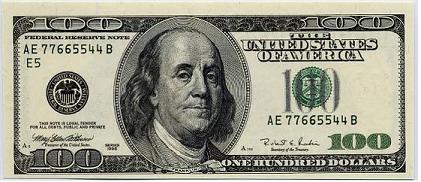
The cool thing about this gift certificate is that I can use it to buy anything I want, since they’ll redeem it just about anywhere. And I don’t have to worry about finding items that add up to just the right amount, because they’ll always give me change.
But seriously: Gift certificates have been around as long as I can remember, but only in the last few years have I noted the arrival of the broad-use gift certificates. You can, for instance, buy a Westfield gift certificate, which can be used at any store in any mall in the Westfield chain. Or you can buy an American Express gift certificate, which can used at any location that accepts American Express cards. The question is, what advantage do these gift certificates have over all of the following: regular gifts, single-retailer gift certificates, and cash?
The simplest – that is, most simplistic - economic analysis says that you should always give cash. Why? Because the recipient knows what she wants or needs better than you do. The worst case scenario is that she’ll use the money to buy whatever you would have bought her, in which case she’s at least no worse off. And otherwise, she buys something she wants more, in which case she’s better off. So if you’re hoping to maximize the recipient’s utility, cash is your best option.
When I teach this lesson to my microeconomics classes, I title it “Why my uncle the economist always gives me money for my birthday.” But as my nephews (and all my other friends and relatives) could tell you, I give them actual presents, not cash. What purpose is served by giving presents instead? Others have tried to answer this question, but here’s a quick summary of leading reasons:
1. To signal to the recipient that you care enough to spend time searching for a gift she’ll like.But if these reasons are good ones, then why give gift certificates? With respect to signaling, the gift certificate says, “I made a little more effort than just visiting the ATM, but not much more,” or “I know you well enough to find out where you shop, but not well enough to know what you’d buy there.” With respect to time saving, the gift certificate is useless because the recipient still has to go out and purchase what she wants. With respect to using superior information, the gift certificate only uses information about location (“I think Jenny might really like Pottery Barn if she would just try shopping there”) but not about specific items. And with respect to accomplishing a goal of your own, the gift certificate may utterly fail unless the chosen retailer has a very narrow selection.
2. To save the recipient the time it would take to purchase the gift. (But this argument depends on your having a sufficiently good idea of what the recipient would want. Also, if your opportunity cost of time is greater than the recipient’s, it would make sense to give cash and increase the amount to compensate for travel time.)
3. To make use of superior information – e.g., you might know, or strongly suspect, that the recipient would really enjoy Book X, which you’ve read and she hasn’t. If you gave cash, she might never try that specific book.
4. To accomplish some goal of your own – e.g., giving an electric razor to your husband who doesn’t shave often enough, or giving an educational toy to a child you think should study more often.
I figure that gift certificates are intended primarily to send positive but weak signals to recipients. The implicit message is: “I thought of you, and I even spent a little time for your benefit, but I don’t pretend to know you very well.” But from the recipient’s perspective the gift certificate can be a hassle, even if its message is well intentioned. The loss in buying flexibility may swamp the gain in warm fuzziness. Hence the emergence of the broad-use gift certificate. This sort of gift certificate sends a slightly attenuated signal – something like, “I thought you merited a small bit of my valuable time” – in exchange for a relatively large, though not unlimited, increase in buying flexibility.
Sunday, December 25, 2005
The Airing of Grievances
 Here’s another example of how Wal-Mart is ruining America. When shopping there last week, I would occasionally see an item and think, “Hey, that would be a really great gift for So-and-So... aw man, it’s too cheap! I’ll have to find another gift to give with it! DAMN YOU, WAL-MART!”
P.S. Have a Merry Christmas, or Hanukkah, or Festivus, or whatever it is you might or might not celebrate today.
Tuesday, December 13, 2005
Optimal Christmas Decorating
So I was looking at my gorgeous Christmas tree, and it got me thinking: aside from the color scheme, what makes a tree beautiful? Clearly the placement of the decorations has something to do with it. But how should ornaments be placed?
Hypothesis #1 is that you want the ornaments in a visible pattern with even spacing. Young children are often attracted to this hypothesis, and it leads them to draw Christmas trees that look like this: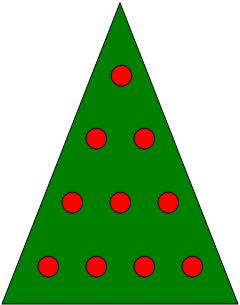 Ugh. That’s no good at all – too regimented, too uniform. Reacting against hypothesis #1 might lead one to hypothesis #2: that ornaments should be arrayed randomly on the tree, with randomness instantiated via a uniform distribution over tree space. But if you really placed each ornament as an independent draw from the distribution, you’d get something like this:
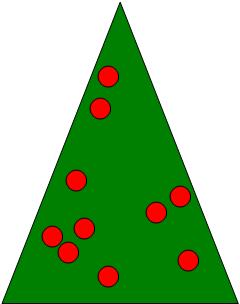 Ooh... strike two. The problem here is that true randomness with independent draws leads to more clustering than most people expect (hence their willingness to believe in “hot shooters” at the craps table). This leads us to hypothesis #3: placement should simulate randomness, but with a constraint on spacing – no ornament too near or too far away from another. The outcome would be something like this:
 Ahh, that’s better! An arrangement like this could, in principle, be accomplished via actual random placement, but with independent draws replaced by some function of distance from prior draws. The more distant a given empty spot is from already placed ornaments, the greater its probability of being selected for the next ornament. And in reality, I suspect our minds are performing just such a process, or at least something similar, when we decorate our actual Christmas trees.
Tuesday, July 05, 2005
Harmonizing the Holidays
I had a great July 4th, but the most surprisingly pleasant part of the day was… the drive. Somehow I managed to dodge all the traffic, both to and from the beach. Not sure how that happened, but it got me thinking about the holiday coordination problem.
For the most part, recognized holidays solve a coordination problem. People typically like to spend their leisure time with other people, so it makes sense for them to take the same days off work. That’s why it sucks when certain institutions choose not to recognize the same holidays as everyone else.
But holidays also create a coordination problem. When everyone wants to travel on the same weekend, we get major congestion on the highways, making the holiday less enjoyable for everyone – or at least everyone who travels, which is why I generally prefer to stay home on the major three-day weekends. A similar problem happens with Christmas shopping: when everyone tries to shop at the same time of year, crowding makes the shopping experience far less pleasant.
The most extreme manifestation of the holiday coordination problem occurs in Europe, where pretty much the whole continent takes off the entire month of August – as my brother and I discovered to our chagrin when traveled in Europe during August of 1990. Almost every train we boarded was packed to the gills, so we spent much of our travel time camped out in the aisles instead of resting in seats. The train stations were madhouses, with every single locker filled, forcing us to schlep our gear through every city we visited. Youth hostels rarely if ever had vacancies. Worse yet, all public accommodations were understaffed – their employees were all on vacation, you see.
Oddly, the August ritual is often touted as one of the virtues of the laid-back European lifestyle. Now, I can certainly appreciate the idea of goofing off for one-twelfth of every year, though I would resist labor policies designed to engineer that outcome (some people value the extra wages more than the leisure). But must everyone do so at the same time? It would make more sense for people to vacation at different times, to reduce the crowding problem while improving the staff-to-customer ratio.
I’m tempted to suggest a similar solution for American holiday rituals. I can’t help wondering if July 4th would be more fun if, say, half the population celebrated it one or two weeks earlier. Two small Christmas seasons might be easier to handle than one big one. But these suggestions will never fly because of the other coordination problem, the one that holidays solve: people want to celebrate the big holidays on the same days as all their friends and family. What happens when a woman whose family celebrates December-Christmas marries a man whose family celebrates January-Christmas? Do they choose (thereby slighting one family), or do they end up celebrating both? I know people for whom the idea of two Christmases is the very definition of a nightmare. But even if you’re okay with a double Christmas, the existence of a growing population that celebrates both would defeat the purpose of the original proposal, which was to have only a fraction of the public celebrating at a time.
Thursday, May 05, 2005
Christmas in Texas
This photo was taken on Christmas Day at my parents' house in Houston. That's my Uncle Rick (standing), me (farthest away), my sister Ellen, and my Dad.

In case you're worried, those are CO2 pellet guns we're shooting, not real firearms. And paper targets we're shooting at, not the neighbors.
Tuesday, February 15, 2005
The Ex-Precedence
Few people want to be alone on Thanksgiving... or Christmas... or New Year's... or Valentine's Day. As a result, many courtships that by all rights should have expired in the autumn linger on into mid-February. Now that V-day's over, the Annual Rite of Overdue Dumping should soon commence, thereby setting the stage for the Spring Mating Season.
This seems a natural time to tackle a sticky issue of dating ethics. Say you’d like to date your best friend’s ex-girlfriend. What should you do? According to the conventional wisdom (which I glean from having watched many sit-coms on the subject), you are supposed to approach your friend and ask if it’s okay.
On first consideration, that doesn’t sound right at all. What, does he own her? Needing permission to date someone else’s ex seems an awful lot like a throw-back to a less liberated era, when women were treated as the property of men. And besides, what kind of lousy friend would say no? Why would a true buddy deny you the opportunity to have some joy in your life? I smell at least a hint of vindictiveness at work.
But a true buddy wouldn’t say no, and that’s the whole point. In this verbal transaction, there is usually only one acceptable response, and it’s yes. So why have the transaction at all? Because it’s an exchange of information. You are informing your friend that you intend to pursue his ex-girlfriend, thereby giving him a heads-up to prepare himself mentally. In addition, there’s a possibility that the apparent break-up was not a real one; sometimes couples officially break up but remain involved romantically. When you ask if it’s okay to ask out your friend’s ex, you’re giving him a chance to fess up to the relationship’s ongoing character. Finally, if he’s a true buddy, he may want to help you avoid a train-wreck by letting you in on the real reasons the relationship failed. If she’s actually a psycho hose-beast, you might want to know it before getting involved.
Hayek is vindicated once again: there is often more wisdom embedded in social customs than meets the eye. (Incidentally, in case any of my friends are reading, this discussion is not motivated by any current events in my life. I have no designs on any of your exes!)
Thursday, December 23, 2004
For All You Last Minute Shoppers
I'm visiting my family in Houston for the holidays (so expect light blogging for the next week or so). Flipping through the Houston Chronicle, I found an article about a new gift-gifting idea: healthcare gift certificates!
At [Dr. Margit Winstrom's] family practice in southwest Houston, pap smears, blood tests, prostate screenings and general office visits can be purchased, personalized and packaged with festive wrapping for Christmas, Mother's Day or birthdays. Each card comes with a description of the service written in calligraphy.Just what I wanted for Christmas -- a prostate exam! Thanks, honey!
P.S. Here's something I wrote two years ago celebrating the commercialism of Christmas. I'm especially lazy this time of year, so I figure I'll just make linking to this old post a Christmas tradition.
Tuesday, December 21, 2004
Solstice Slugfest!
Hoo, doggies, but my post about Santaism got 'em going! The 25 comments may have set an Agoraphilia record. I thank you all. I love a good holiday dust-up, especially one that comes just in time for our celebration of the True Reason for the Season: Winter Solstice.
I especially appreciated how my wife, d, jumped into the fray to defend me and her family. Picture a bar fight in which a man is momentarily overpowered. In the stock movie version, his woman saves him by blind-siding his foe with a bottle. In contrast, d would break the bottle in half, grab its neck, step in front of the bad guy, and growl, "Back off or eat glass, punk." And yet, far from a thick-necked burly-girl, she's a total babe!
As to the merits of the argument, I found most convincing Glen's explanation of why parents lie about Santa. He wrote, "Santa provides a reward-and-punishment scheme that *appears* out of the parents' hands. 'I can't help it if you didn't get many gifts -- I guess *Santa* thought you were naughty.'"
That jibes with something I've often observed: Discipline probably constitutes the most unpleasant of a parent's duties. Contrary to what kids may think, it is no fun to see someone you love feeling ashamed, sad, or angry with you. Yet parents who skimp on discipline exhibit not kindness but sloth and selfishness.

Sunday, December 19, 2004
Why Preach Santaism?
Lots of parents lie to their children, repeatedly and ardently, about the existence of Santa Claus. Why? Santaism imposes large costs on parents, both the moral costs of lying and the opportunity costs of losing credit for well-regarded gifts. Yet Santaism does not appear to offer countervailing benefits. You don't need that mythical construct to tie good behavior to good gifts; parents routinely use carrots and sticks to get their kids to act appropriately. As d said of Santa Claus last night, during our long drive home from a dinner party, "What's in it for the parents?"
I can think of a few answers, though I don't regard any as very satisfactory. Herewith a quick survey: 1) Unthinking adherence to custom leads parents to ignore the unimpressive cost/benefit ratio of Santaism; 2) Convincing kids about the existence of Santa offers parents the benefit of exercising over their children the power afforded by superior knowledge, a form of power useful in other areas of socialization; 3) Parents who feel anxious about their ability to provide pleasing gifts regard Santa as a form of insurance—he offers a convenient fall guy.
As should be evident, we don't practice Santaism in our household. It's not just that the costs outweigh the benefits for us parents, either. We think that exploiting the trust of your kids, setting them up for an inevitable and heart-breaking disappointment, imposes large net costs on them.
Wednesday, December 24, 2003
Merry Christmas!
Merry Christmas to all! I have nothing new to say about this holiday, but here's something old (from this blog a year ago).
Friday, January 03, 2003
Regifting
According to this Reuters story, the Christmas shopping season may be "extended" this year because of the unexpectedly large number of people who gave gift certificates. Tell me about it. When I was in Restoration Hardware about a week before Christmas, I overheard an employee ask her manager if it was okay for a customer to use a gift certificate to buy… another gift certificate. (The answer was yes.)Saturday, December 28, 2002
Unfinished Business
Amy sent me a few more suggestions for clever group names:A bouquet of floristsShe also favors “fathom” as the group name for philosophers.
A yard of landscapers
A sextet of prostitutes (but why would they travel only in 6’s?)
Unlike the group name game, the best-and-worst Xmas song contest only got two entries – mine and my sister’s. Consequently, every category had either a unanimous winner or a 50-50 tie. Here they are:
Best Classic: Tie – “God Rest Ye Merry Gentlemen” and “O Holy Night”There were plenty of honorable mentions in the worst modern category, and I don’t want to leave them out: “All I Want for Christmas Is My Two Front Teeth,” Bruce Springsteen’s version of “Santa Claus Is Coming to Town,” Paul McCartney’s “Wonderful Christmas Time,” and any Christmas song done by the Chipmunks.
Worst Classic: Tie – “The 12 Days of Christmas” and “I’ll Be Home for Christmas”
Best Modern: “Christmas Wrapping” by the Waitresses
Worst Modern: “Last Christmas I Gave You My Heart” by Wham!