Robert Morse today announced that, in response to evidence that law schools had been gaming its rankings, U.S. News would change the way it estimates the "Employment at 9 Months" measure for schools that decline to report that figure. Paul Caron offers some background here. Said Morse: "U.S. News is planning to significantly change its estimate for the at-graduation rate employment for nonresponding schools in order to create an incentive for more law schools to report their actual at-graduation employment rate data. This new estimating procedure will not be released publicly before we publish the rankings."
I understand that U.S. News generated the formula it formerly used to estimate the Emp9 figure for non-reporting schools by running a regression comparing the Emp0 and Emp9 data from reporting schools. It used to puzzle me that U.S. News did not evidently re-run the regression each year, but rather stuck with the original estimate. In retrospect, though, I see that sticking to the same formula might have partially helped U.S. News offset the gaming it so dislikes. After all, as more and more schools with low numbers refused to report Emp9 data, opting to rely instead on the publicized formula, the correlation between Emp0 and Emp9 scores would change so as to favor non-reporting schools. Better to stick with the old formula, dated though it might be, than to increase the incentive to opt out of reporting.
U.S. News thus avoided a vicious cycle, but only at the cost of signaling to schools exactly when hiding Emp9 data would help their rankings. Will its new reticence work? Schools can now only guess at how U.S. News will turn Emp0 numbers into Emp9 estimates, and will rightly worry that they might misjudge the new cutoff. Even if big-E ethics does not counsel reporting Emp9 numbers, therefore, small-c conservatism will. Granted, a school might reason, "U.S. News will still try to find a reasonably accurate way to turn Emp0 data into Emp9 estimates, and it has always helped us to not report in the past, so it remains a gamble worth taking." But such schools should also rightly worry that U.S. News might throw a punitive little kick into its new formula, to encourage schools to worry more about accuracy than about rankings.
[Crossposted at Agoraphilia and MoneyLaw.]
Thursday, May 20, 2010
U.S. News: Less Transparency = More Fairness


Monday, November 26, 2007
Psychopaths as Hawk Strategists
I recently stumbled on a year-old article about psychopaths. The article offers various explanations for why psychopaths exist, but this one I found most interesting:
Evolutionary psychologists regard psychopathy as an inherited personality style that has evolved because glib, deceitful individuals—as a minority within a larger population of trusting folk—often reproduce with much success.So in other words, psychopaths are Hawks in the Chicken game of life. What’s nice about this explanation is that it not only explains why psychopaths exist, but also why we’re not all psychopaths. If there are few enough psychopaths in the population, then being a psychopath makes sense because you’ll mostly have winning confrontations with nice people. But if there are too many psychopaths, then the gains from taking advantage of nice people will be swamped by the losses from confronting other psychopaths. In equilibrium, you’ll get both psychos and nice folks, with each strategy generating approximately equal returns, and with the precise balance determined by the relative payoffs of different interactions.
With that explanation on the table, I found this one less plausible: “Other investigators ... regard psychopathy as the result of a still-unspecified genetic disorder. The inherited defect interferes with the workings of the brain's emotion system, which is centered in the amygdala, a structure especially concerned with perceiving dangerous situations.” Possible; but if psychopathy is a genetic defect, you have to wonder why it hasn’t been more completely weeded out of the population. Genetic defects can persist, of course, but usually because they produced some kind of balancing benefit in some evolutionary environment – e.g., the heterozygous form of sickle-cell anemia provides some protection against malaria. So when I see an alleged “defect,” I always look for the adaptive explanation.
Thursday, November 01, 2007
Halloween 2007
So last night I won $200. I'm not sure which contest I won -- Best Costume, Best Original Costume, or Best Karaoke Performance. But a buddy says someone else won the karaoke contest, so it must have been one of the costume ones. I was a twisted version of the Tooth Fairy. Here I am:
And here's a close-up of my belt. Yes, that's an actual coin changer, along with real surgical tools:
And here's an extraction in progress:
And here's my karaoke performance (no audio file, sorry): Good times!
Friday, October 12, 2007
A Nation of Pansies and Party Poopers
I stopped by the Halloween store this afternoon to pick up some items for my costume, and I overheard a phone conversation between the store manager and Halloween store HQ. The manager was being told to remove all toy guns from the shelves because they are against the law.
Unbelievable.
Wednesday, April 04, 2007
Game Theory, in Concert
I'll soon offer my Contracts II students a performance of "Excuses," a country-and-western flavored song that illustrates the defenses of mistake, impracticability, and frustration of purpose. I began that annual tradition in 2005. This year, though, I aim to add something new. Since I'll have my guitar on campus, anyhow, and since I've got several new compositions I'd like to air, I plan to hold a twee concert fundraiser, open to all students and faculty. Here's the poster I worked up to advertise the event: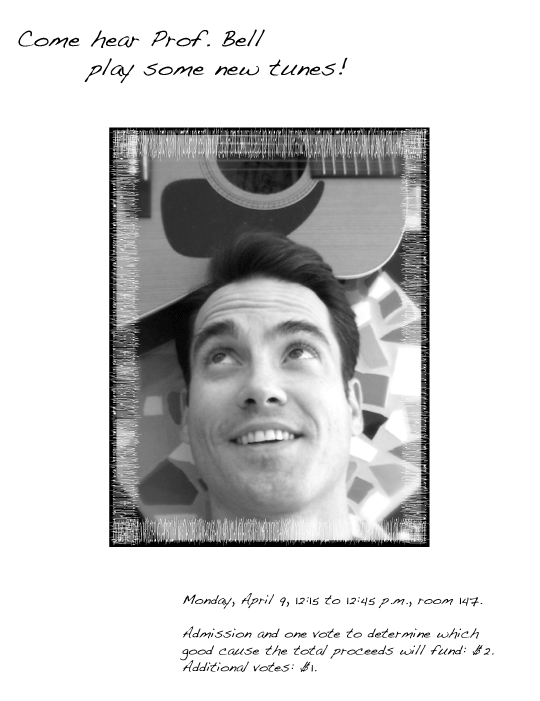
What good cause will the concert fund? I'll let the audience decide. Specifically, I'll let them vote between two options: An "Entertainment Law Study Scholarship" (which will help its recipient defray the cost of textbooks and provide a nice addition to his or her C.V.) or a contribution to support the woefully underfunded law school newspaper, "The Courier." As the poster indicates, each person who buys a $2 ticket to attend the concert will automatically get to cast a vote in favor of one of those two options. Additional votes will cost $1/each. The good cause that gets the most votes will get all of the concert's revenue.
Why that unusual arrangement? I figure that it might encourage strategic vote buying by parties especially eager to steer the collected funds towards their favorite causes. That effect would, of course, increase the total amount of money raised. Granted, my scheme presents some complications. Properly administered, though, I think it might provide some good, clean fun. It might illustrate a thing or two about game theory, too.
Tuesday, October 31, 2006
Trick or Triage
Every once in a while someone will ask how I came to be an economist. I’ll usually tell them a story about sitting in my undergrad poli-sci classes, where I listened to my fellow poli-sci students talking about economic policy without having the slightest clue about economics. But I wonder if the real story goes much further back, to the Halloweens of my youth… [cue wavy flashback lines]
When my brother Neal and I were kids, our mom kept us on a very strict diet. We were not allowed to have anything with added sugar of any kind. She contended that added sugar made us hyperactive and inclined to misbehave three days after eating it. I remember sometimes I would sneak to the 7-Eleven, buy and consume some candy, and then wait three days to see if I got in trouble with Mom three days later. (Apparently I had intuitively grasped the idea of a single-blind experiment, but I had not yet caught on to the double-blind experiment.) But there were never any sweets around the house, and my allowance was limited, so most of the time I went without.
Mom did, however, make exceptions for holidays. After that first Easter after the diet began (when I was about 6 years old), when I was sorely disappointed to find my plastic eggs filled with Nutrigrain cereal, Mom did allow a limited amount of sweets on special occasions. Halloween was one such occasion. But if she had allowed us to keep eating candy for as long as our stashes lasted, the exception could have lasted for weeks! So she implemented the dreaded 24-hour rule: all Halloween candy had to be consumed within 24 hours, or else get thrown away.
This meant, of course, that November 1st involved even more belly-ache-inducing gorging in the Whitman household than anywhere else. It was my duty, my quest, to make sure not a single piece of candy went to waste. And usually I succeeded. But one Halloween when I was about 11, one of my last years of trick-or-treating, the haul was just too large. By about 5:00pm on November 1st, it had become apparent that I would never make it.
And that’s when Neal – who had stopped trick-or-treating a year or two before – came to my rescue. Not by eating the extra, but by teaching me the art of trick-or-triage. He explained that the goal was to eat as much candy as possible in a limited period of time. He then helped me to separate my remaining pile into categories. In one category were the good candies that could be eaten very quickly, such as small chocolate bars. In another category were the mediocre candies that took forever to eat, like Sugar Daddies. A third category consisted of those lousy generic black-and-orange-wrapper candies, which were hardly worth eating in any case. Clearly, it was in my interest to focus on category one at the expense of categories two and three. A fourth category consisted of pretty good candies that took a long time to eat, such as Jolly Ranchers. This category posed a problem. But as Neal helpfully observed, these candies were also typically the least perishable and easiest to hide. Hard candies could spend months in the sock drawer without going bad, thereby allowing me to indulge in small exceptions – er, experiments – throughout the year.
I wasn’t able to finish all my candy that year, but with Neal’s help, I successfully maximized my candy-consumption subject to an exogenous time constraint! Neal ended up becoming a linguist, but his good work one All Saints Day may well have planted the seeds for my development into an economist.
Thursday, October 26, 2006
Drug Fiends
The bad news: Kids are dressing in paramilitary gear to celebrate the drug war.
The good news: At least kids are dressing as actual monsters for Halloween again. Before, they were the sort of monsters who eat your brains and suck your blood; now, they’re the sort of monsters who knock down your door, shoot your dog, beat up your grandparents, and steal your stash.
Tuesday, October 24, 2006
Scared Shift-less?
Last week, Julian found this risible op-ed in the New York Times about how sexy costumes are ruining the family-friendly character of Halloween. Julian’s sarcastalicious reply letter said, among other things:
I'm sure the glob of clay little Timmy brought back from nursery school, with "Worldz Graytest Mom" scrawled on it, is an exceptional piece of art, but it confers no special rights. It entitles you to no special authority over the direction of American culture. It does not obligate the rest of us to water down our entertainment in order to spare you the burden of cracking the manual on the cable box that came with all those terrible, filthy channels you're paying $40 a month for. It certainly doesn't require us to defer to your judgment about which occasions are "family holidays" to be celebrated in whatever manner you're comfortable with. There is, I realize, the risk that the instant they're old enough to stop brunching at your nipple, your precious tots will be scarred for life by the sight of a bit of cleavage, but I feel confident they'll recover somehow.So I’d been chuckling about that passage for several days, and planning to link to it eventually but never getting around to it. And then what should appear in the O.C. Register but another article denouncing the same trend! And how’s this for irony: while the reliably-left-wing Times included an op-ed decrying the trend on family-values grounds, the reliably-right-wing Register included an article decrying the same trend on feminist grounds. I would say this constitutes further evidence for the theory that editorial page editors choose their guest writers to make their ideological opposites look like dopes, except the Register article appears in the “Life” section.
To the author’s credit, she doesn’t actually espouse the feminist line herself, but she does let a women’s studies prof speak authoritatively without the barest hint of dissent:
"Looking sexy is now considered normal, feminine behavior for a woman, so on a day like Halloween, women will take it as creative license to wear revealing clothing and no one can call them a tramp that day," said Donna Gough, an assistant professor of women's studies at Cal State Fullerton. "And for men, it's a day where they can openly stare at and drool over women in such attire without being called a chauvinist pig." … "The message being sent for a woman is that you have to wear these costumes to fit in and be normal and be considered attractive and appealing to men," said Gough.That’s right – all those women wearing French maid uniforms and scanty cavewoman skins have been pressured into it by our chauvinistic culture. Of course, most women I see in such outfits seem positively giddy about it, but I suppose that’s just false consciousness.
How exactly did the sexification of Halloween occur? I must have missed the meeting where the boys all got together and hatched their dastardly scheme to overstock the costume shops with slinky stuff. Or maybe it was a decentralized process – probably one of those zero-sum status-seeking games I’ve been hearing about. Women who dress up sexy make other women look frumpier by comparison, so they have to sex it up too, and pretty soon they’re all shivering at outdoor Halloween parties without having gained any relative advantage. I suppose Robert Frank would recommend a bare-skin tax. I recommend throwing a big shapeless sheet over your head and going as a ghost. Then you can either cut out eyeholes (if you want to see) or go eyehole-free (to protect your corneas from being seared by the sight of skin).
(All right, I can’t out-snark Julian, but I sure can try.)
Monday, January 24, 2005
The Secularity Gradient
Does maintaining a strict separation of church and state presuppose the existence of a sharp distinction between religious and secular matters? For a long time, I have (implicitly) assumed such a distinction to exist. Now I’m not so sure.
The question came to mind when I heard about school choirs that perform Christmas celebrations composed of only the secular Christmas carols (“Jingle Bells” – OK, “Away in a Manger” – not OK). Now, as an atheist who celebrates Christmas, this doesn’t bother me much, although I admit that some of my favorite Christmas songs are the religious ones. The notion that Christmas has a secular component makes perfect sense to me. Halloween provides an even clearer example of how an essentially religious event can become almost entirely secularized.
Yet Christmas and Halloween both lie on a spectrum. The only difference between the two is the number of people who still regard them as primarily religious events. Note that Halloween’s secularity is questioned by two different groups – the modern-day pagans who still treat it as a holy day, and the fundamentalist Christians who decry it as a form of Satanism. We do not have a sharp line between the religious and the secular, but a gradient. If enough people adopted my attitude toward Christmas, then Christmas might move down the gradient into the “mostly secular” zone occupied by Halloween.
So how should these holidays be treated by the state? Ought teacher-led celebrations of both events be banned from public schools, on grounds that celebrating either violates the establishment clause of the First Amendment? Or should both be allowed, on grounds that both have secular components that all students can enjoy? Or should the courts adopt a wishy-washy balancing rule, putting judges in the position of deciding whether the secular component of any given event is great enough to overcome church-state concerns?
I don’t have an answer to the question, so I pose it to my readers. I will just add that I see one relatively simple way to finesse problems like these: implement a voucher system, so that parents can choose the degree of secularity to which their children will be exposed.