I earlier promised some graphs to illustrate a parable about copyright's future. I'd like to start, here, by offering a picture of the standard economic model of IP. (Attentive readers may recall that whereas other use "IP" for "intellectual property," I use it to stand for "intellectual privilege"). See figure 1, below: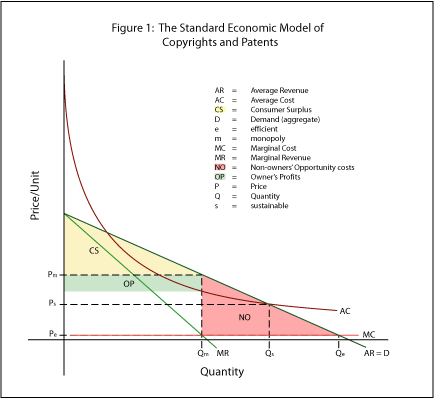
This portrayal of the standard model comes largely from Christopher S. Yoo's brilliant paper, Copyright and Product Differentiation, 79 N.Y.U. Law Rev. 212, 227 fig. 1 (2004) [PDF]. Yoo's paper both sums up the traditional view among legal academics of the economics of copyrights (a view which, at this level of generality, applies as well to patents) and corrects it by setting the proper bounds for measuring profit. I've modestly amended Yoo's version by showing average costs to exceed average revenue at low levels of production—an assumption that, while not strictly necessary, doubtless does a better job of describing most copyrighted works.
More interestingly, Yoo's paper criticizes the standard model as inadequate and offers an alternative way of understanding the economics of copyright. I've only recently come across his paper, and am still digesting it. So far, at least, I find much in it to like, even though it may lead me to take a somewhat less skeptical view of copyright policy. For present purposes, though, I'll stick with the standard model. I'm not quite ready to abandon it and, at any rate, I don't think that in this particular case that it generates an analysis materially different from the sort that Yoo's model would generate.
[Crossposted to The Technology Liberation Front.]
Wednesday, August 29, 2007
The Standard Economic Model of IP


Econ Top 100
Agoraphilia appears in CurrencyTrading.net's list of the top 100 economics blogs. I would have been hard put to name 100 economics blogs at all!
Tuesday, August 28, 2007
Tortured Logic
James Miller at Overcoming Bias argues that we have a bias against torture as a form of punishment. Using torture instead of imprisonment could achieve equivalent results (in terms of deterrence and so forth) at lower cost. The claim of cruelty doesn’t really fly, says Miller, because criminals would be indifferent between their existing punishments and appropriately selected tortures:
Some would argue that it’s excessively cruel to torture criminals. But both prison and torture impose costs on criminals. Why is one type of cost crueler than the other? If a convicted criminal is indifferent between receiving a certain type of torture or being imprisoned for a given period of time then why would it be excessively cruel to torture but not to imprison?I think this is all correct, but misses the point. If we consider only the incentives of criminals, then the prohibition on torture seems rather pointless (so long as we don’t delude ourselves into thinking it will be very effective in eliciting information, like the site of planned terrorist attacks). But the prohibition on torture makes much more sense when we consider the incentives for the rest of us, in our role as voters and policymakers. The possibility of torture allows us to indulge our very worst impulses at low cost. As John Locke observed, one problem with humans in the state of nature is our willingness to impose excessive punishments on each other to remedy perceived violations. Torture enables us to exact harsh retribution without any great sacrifice. If torture is not frowned upon, the foreseeable result is to encourage excessive punishment of things that should be crimes (murder and so on) as well as to widen the net of state control over things that should not be crimes (like drug use). Given our built-in impulse to punish others for things we dislike, it’s actually a good thing that punishment is costly to those who impose it.
Monday, August 27, 2007
A Parable About Copyright's Future
When more players enter the market for expressive works, an author faces both new competitors and new customers. What affect does that have on copyright's power to stimulate authorship? Assume, both for the sake of simplicity and because it seems reasonable, that the ratio of authors/consumers holds steady. I posit that copyright will in that event offer greater rewards for authorship. Allow me to explain, here with a parable, and in a later post with some graphs.
The Parable of the Village Authors
There once existed an isolated village of 1,001 people. Of them, only Amarel had the gift of writing entertaining words. Many villagers valued her tales, so the counsel of elders instituted a copyright law to encourage her authorship. Thanks to that law, Amarel earned a decent living, selling one new story a week for a dollar apiece.
Only 500 of the villagers purchased Amarel's works, however. The rest, who preferred music to literature, found her work a bit too pricey for their tastes. And opinions about her work varied even among the 500 villagers who did purchase it. Two hundred and fifty of them, who preferred poems to prose, found it just barely worth the cost. The remaining 250 found her stories precisely to their liking—so much so that, had she only known, Amarel might have charged them nearly $1.50/work.
One day a group of 1001 refugees appeared. Their homes had been wiped out in a flood, so they sought permission to settle in and around the village. The counsel of elders, having pity on the refugees and judging them very much like their own people, agreed. The village thereby grew to include 2002 people.
The newcomers included Berek, who shared with Amarel a gift for writing. In his old home, he had played a role almost exactly like that played by Amarel in hers. He had enjoyed copyright protection, earned a living selling his works to half of his neighbors, found 250 of his customers complacent, 250 of them ardent, and so forth. Whereas Amarel wrote stories, however, Berek wrote poems.
What happened when Amarel and Berek began to compete for customers in the newly enlarged village? Amarel lost to Berek 250 of her customers—those who favored poetry to prose. She kept the 250 customers who had always regarded her stories as a bargain, however. Amarel found among the former refugees 250 new fans, moreover, who happily purchased from her the prose that Berek had denied them. Berek experienced the same turn of fate, trading 250 barely satisfied customers for 250 devoted ones.
The growth of the village thus left unchanged the number of customers served by Amarel and Berek. It allowed them, however, to better serve what customers they had. Amarel could focus on the villagers who favored prose, whereas Barek could focus on those who favored poetry. The authors thereby found that they could raise their prices and win greater profits. Their customers gained, too. Granted, they now had to pay more. But most of them were happy to finally get the art they loved best, and all of them paid less than they thought the art worth.
Who did lose? The villagers who, though unwilling or unable to pay $1.25 for the right, would have enjoyed reading Amarel or Berek's words. Though it would have cost next to nothing to make sufficient copies to satisfy those villagers, copyright stood in the way. Thus were many simple joys foregone.
Moral: As the market for expressive works grows, assuming that the ratio of authors to consumers does not increase, copyright owners tend to earn larger profits.
[Crossposted to The Technology Liberation Front.]